Great Fountain, fountain in Hannover, Germany
The Great Fountain is a central water feature in the Herrenhausen Gardens in Hannover and can shoot water up to 80 meters high. It combines a complex system of pumps with formally designed garden spaces arranged symmetrically around this focal point.
Work on the Great Fountain began around 1700 as a prestige project of Elector Georg Ludwig, later King George I. Because the flat site offered no natural fall, water had to be raised by machine: from 1718 the English engineer Thomas Holland's design was built, with a 52-metre weir on the Leine and a timber engine house holding five water wheels of 9.4 metres driving 40 pressure pumps. The fountain has run regularly since 1720.
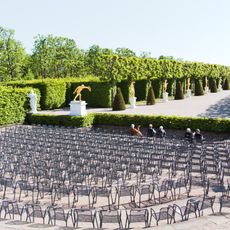
The fountain sits at the star-shaped crossing of the main and cross avenues in the southern garden half, the Nouveau Jardin laid out from 1696 as a bosquet garden. Its jet was meant to rival the 27-metre Bassin du Dragon at Versailles, and it was run only on special occasions, like a ruler appearing before the court.
The basin sits at the star-shaped crossing of the main and cross avenues in the southern bosquet garden, so it is reached on foot along the gravel paths. The jet is best seen on windless days, when it rises 72 metres; with wind it is shorter. The water is pressed through a 4-millimetre circular slit at up to 140 km/h.
The fountain's jet is hollow: water is forced through a 4-millimetre circular slit at up to 140 km/h, so the display uses only about 500 m³ per hour. Since 1956 an electric pump works has drawn groundwater to keep it running. The sandstone basin is over 50 metres across.
The community of curious travelers
AroundUs brings together thousands of curated places, local tips, and hidden gems, enriched daily by 93,181 contributors worldwide.