Evangelisch-Reformierte Kirche Hohenlimburg, Reformed Protestant church in Hohenlimburg, Germany.
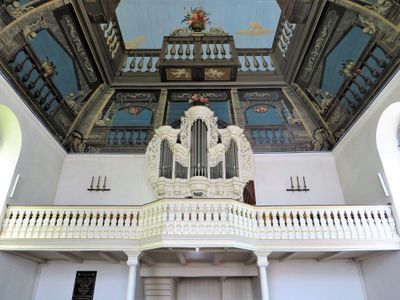
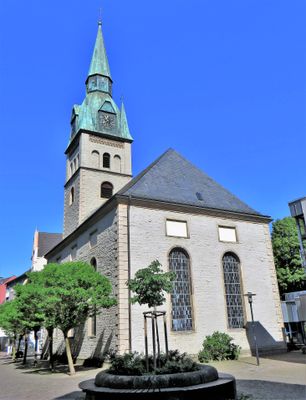
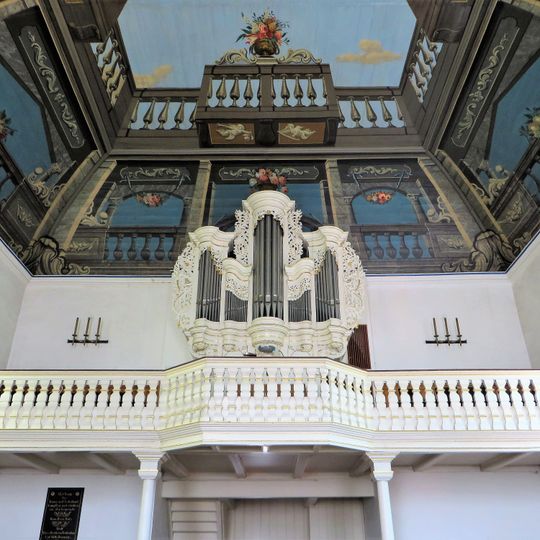
The Evangelisch-Reformierte Kirche Hohenlimburg is a single-nave rectangular church built 1749–1751 on the site of the medieval Marienkapelle. Its square light-grey stone tower carries a green copper spire with a gold-numeral clock face, while the lower hall has pale plastered walls, a steep dark slate roof and two tall arched windows with white tracery. Inside, a vaulted wooden ceiling in Renaissance style bears a baroque painting of a palace gallery with blue sky, putti and white clouds.
Built between 1749 and 1751 on the site of the medieval Marienkapelle, the church was funded by Count Moritz Casimir I of Bentheim-Tecklenburg, who also authorised a collection recorded in a book listing donors from Stift Elsey, northern Germany and the Netherlands. The tower, originally 22.5 metres without a spire, was raised in 1865/66 and again in 1898/99, when it received its copper covering; it now stands 50 metres high.
The pulpit's carved palm tree and the ceiling painting of a palace gallery with putti follow Reformed tradition: no biblical scenes. The year 1767 on the hymn board marks the first shared hymnal. The tower entrance holds the grave slab of Countess Albertine Henriette zu Ysenburg-Meerholz (1703–1749).
The church is centrally located in Hohenlimburg and easily reached on foot; visitors should ask about regular service times before arriving. For tours or special visits, calling the church office beforehand helps confirm opening times and availability.
Behind the white baroque organ case carved by court joiner Johann Caspar Rodermund sits a modern instrument with 21 stops, installed by the Bürkle organ workshop of Schwelm in 1967. The carved case, gilded and topped with a small vase of flowers, is what visitors see from the balcony.
The community of curious travelers
AroundUs brings together thousands of curated places, local tips, and hidden gems, enriched daily by 94,353 contributors worldwide.