St. Jakobus, Church building in Rosenberg, Germany
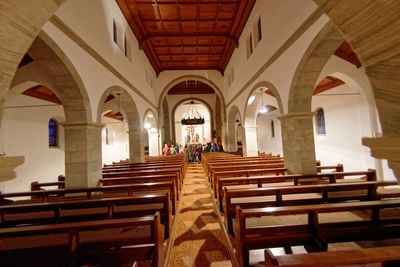
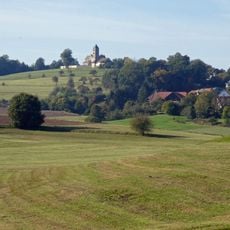
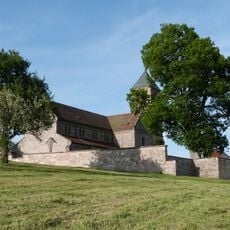
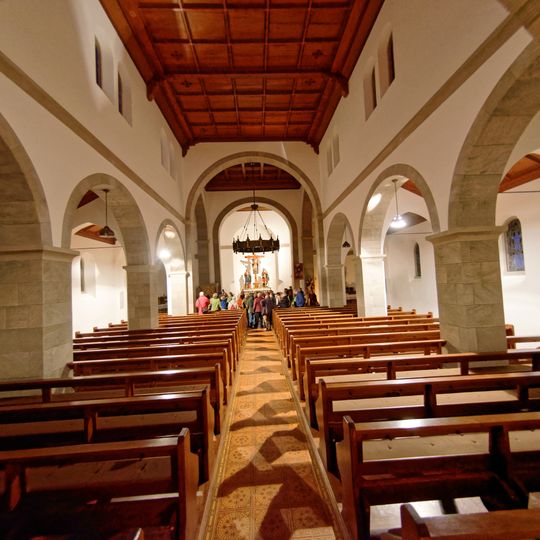
St. Jakobus stands on the summit of the 570-metre Hohenberg in Rosenberg, eastern Baden-Württemberg. The church, first built in the early 12th century, received its present neo-Romanesque form in a restoration of 1896. Inside, a flat brown wooden ceiling covers the nave, which is flanked by dark wooden pews and lined with stone arches on square light-grey pillars; a multi-branched chandelier hangs before the recessed altar with its crucifix.
A document of 1229 names a provost of Hohenberg, and building analysis dates the church to the early 12th century, when it had a nave and a north aisle. A fire caused by lightning destroyed the roof and bell frame; the rebuilt walls created a single wide nave with Gothic windows. In 1460 the Ellwangen provostry was dissolved and the church became a parish church.
The interior houses an altarpiece created by Sieger Köder, an artist who also served as parish priest here and filled the space with his own religious works during his time.
The church holds regular services and has space for concerts, while also serving as a stop on a pilgrimage route from Würzburg. Its location on the hilltop makes it a natural place to visit while exploring the area.
The 1332 indulgence letter, issued in Avignon and signed by an archbishop and eleven bishops, grants forty days of indulgence per bishop. It shows James with hat, staff and scallop-shell bag. A blaze triggered by lightning destroyed the nave roof and bell frame; the bells later hung in the north transept roof until 1895/96.
The community of curious travelers
AroundUs brings together thousands of curated places, local tips, and hidden gems, enriched daily by 94,548 contributors worldwide.