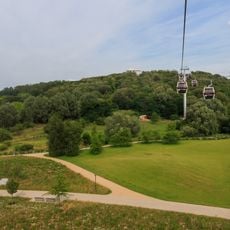
Kienbergpark, Public park in Marzahn-Hellersdorf district, Berlin, Germany.
The Jelena-Šantić-Friedenspark, known as Kienbergpark, is a nine-hectare green space on the eastern bank of the Wuhle in Berlin-Hellersdorf. It was created on a former wasteland and includes a hill about 60 metres high, a plateau loop path, a rain retention basin, and the Hasenpfuhl pond formed from a flooded excavation pit. A large peace sign made of stones and flowers marks the slope.
The park was created on former wasteland and opened in July 1996 as Rohrbruchpark, following a 1994 landscape design competition won by Bureau B + B from Amsterdam. It was renamed Jelena-Šantić-Friedenspark on 22 March 2003 after the Serbian peace activist and prima ballerina Jelena Šantić, who had attended the opening. For IGA 2017 it was integrated into the Kienbergpark with a new section, the Märkischer Garten.
The park's name honours Jelena Šantić, a Serbian peace activist and prima ballerina who attended the July 1996 opening and inaugurated the oversized peace sign laid out in stones and flowers on the slope. In 2003 the park, first called Rohrbruchpark, was renamed after her at the suggestion of the Berlin peace group Gruppe 485.
The park is easily reached by the U5 metro line from central Berlin, and continuous pathways allow visitors with strollers or wheelchairs to move through comfortably. Clear signage helps unfamiliar visitors navigate the grounds easily.
The park's landmark is an oversized peace sign laid out on the slope in stones and flowers, borrowed from the 1950s anti-nuclear movement and visible from the air. Jelena Šantić, the Serbian peace activist and prima ballerina after whom the park was renamed in 2003, attended the 1996 opening and inaugurated the symbol herself. Militant opponents have damaged it several times, so police and private guards were deployed.
The community of curious travelers
AroundUs brings together thousands of curated places, local tips, and hidden gems, enriched daily by 94,490 contributors worldwide.