Johanneskirche, Protestant church in Neu-Isenburg, Germany
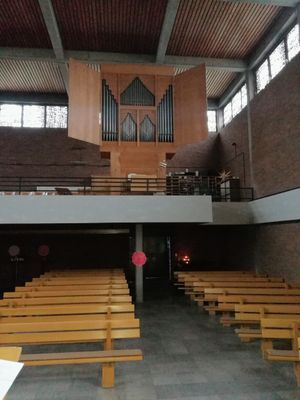
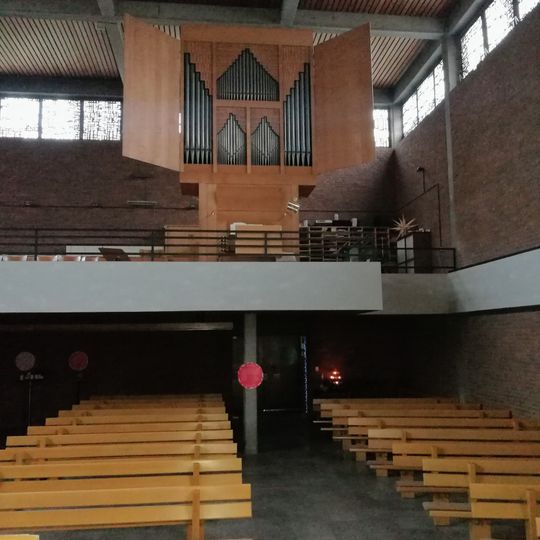
The Johanneskirche is a modern church building in Neu-Isenburg, built from 1966 to 1968 to designs by architect Harry Hintereder. Its interior features a tall wooden organ on a rear balcony, with a light brown case whose two large side panels fold open like wings. The organ's metal pipes are arranged in five sections, and a metal railing runs along the balcony edge below it.
The Johanneskirche emerged from the destruction of the Reformed church Am Marktplatz, hit in a British air raid on 20 December 1943. Services moved to a kindergarten barracks on Schillerstrasse, and a community house opened in 1955. The Johannesgemeinde became independent on 1 April 1958. Architect Harry Hintereder won the 1963 competition; excavation began in August 1966, the topping-out was in January 1967, and the church was consecrated on 7 December 1968.
The interior features artworks by sculptor Harro Erhart that shape the altar wall, baptismal font, pulpit, and entrance doors. These pieces give the space a personal and artistic character.
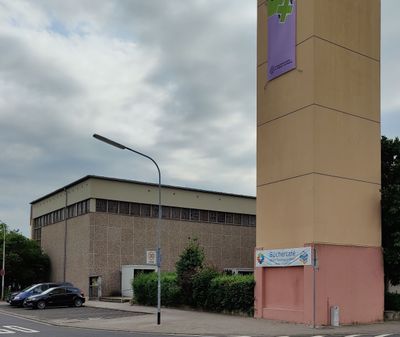
The church stands in the west of Neu-Isenburg, where the congregation moved after its market-square church was destroyed in 1943; the community centre that preceded it was finished in 1955. Services are held in the building, and the organ loft is reached by the rear balcony, where the instrument stands behind a metal railing.
The organ was built by the Ahrend workshop in Loga, East Frisia, and entered service on 18 February 1973 after four and a half years of construction. The mechanical instrument has 17 stops on two manuals and pedal, with tin pipes in an oak case. Its two bells from the Rincker foundry in Sinn sound the interval b′–des″.
The community of curious travelers
AroundUs brings together thousands of curated places, local tips, and hidden gems, enriched daily by 94,023 contributors worldwide.