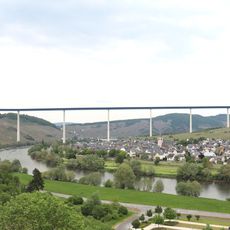
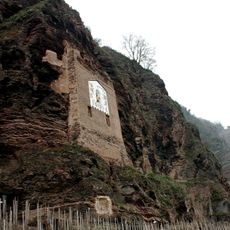
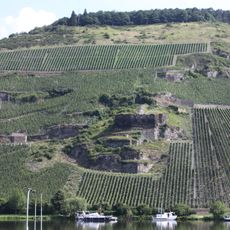
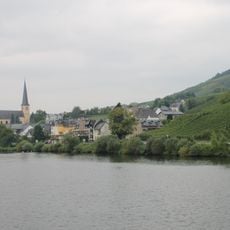
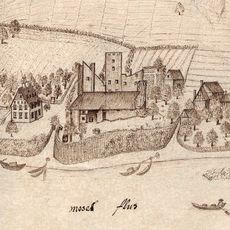
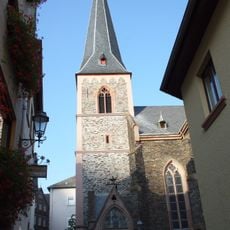
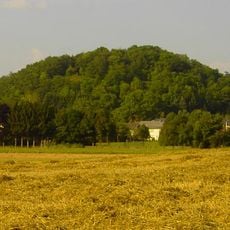
Wall section of the Erdener Burgberg, German promontory fort in Erden, Germany.
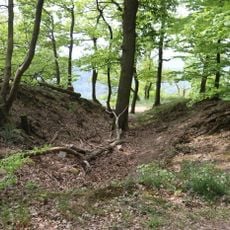
The wall section of the Erdener Burgberg is a Celtic fortification on a hilltop above the Mosel opposite Erden. It is protected only on the north by a rampart system, while the 300 m south side is bounded by a steep slope with sheer rock walls. The enclosed area covers about 307 ares, measuring 230 m by 125 m.
Built around 150 BC by the Celtic Treveri, whose farms lay in the nearby Alf valley and along the Mosel, the rampart was probably a refuge rather than a permanent settlement. Excavations by the Rheinisches Landesmuseum Trier in 1975 found postholes but no further traces of internal buildings. After Rome conquered the Celtic lands between 58 and 51 BC, the refuge lost its purpose.
The site is named after the Burgberg hill above Erden, and its builders were Celtic Treveri whose farms lay in the nearby Alf valley and along the Mosel banks. Paul Steiner called it "a forgotten Mosel castle near Erden" in the Trierische Landeszeitung of 4 March 1933. Excavations by the Rheinisches Landesmuseum Trier followed in 1975.
The site is accessible year-round and sits within a hiking region with many trails through the Mosel area. Sturdy footwear and suitable clothing for outdoor conditions are recommended, as the ground is uneven and sometimes steep.
In the section recorded as Schnitt I, excavators found a 5.10 m wide dry-stone wall of slate whose 1 m thick outer face had 15 cm gaps left by decayed wooden posts, proving it was a post-slot wall (Pfostenschlitzmauer). A 4 m wide ditch, 1.20 m deep, ran in front of the rampart.
The community of curious travelers
AroundUs brings together thousands of curated places, local tips, and hidden gems, enriched daily by 93,562 contributors worldwide.