Villa Duttenhofer, Historic villa in Rottweil, Germany.
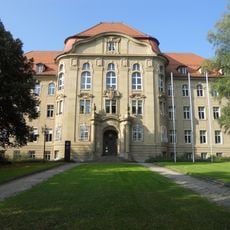
Villa Duttenhofer is a two-storey building on an almost square plan, topped by a hipped roof. Its exterior is divided by a polygonal corner oriel, horizontal rusticated plasterwork, cornices and segmental-arched windows. The core is the free-standing 1857 house of powder manufacturer Xaver Flaiz, which Emil Otto Tafel enlarged from 1878 for Max von Duttenhofer; it stands at Königstraße 1, at the entrance to Rottweil's old town.
The core of the villa is a free-standing house built in 1857 for powder manufacturer Xaver Flaiz. Max von Duttenhofer inherited it and had Stuttgart architect Emil Otto Tafel enlarge it from 1878, adding a domed salon, a large hall, a winter garden and stables in 1884. The city of Rottweil has owned the property since 1919.
The villa served as a prestigious venue where the Rottweiler Narrenmarsch was premiered in 1899, and it hosted the Württemberg royal couple, establishing its cultural significance.
The villa at Königstraße 1 has stood empty since 2009, so there are no interiors or guided tours to visit; it is seen from the street. A pavilion added to the south in 1998 was demolished in 2010 when its lease ended. The building is a protected monument within the former Rottweil powder factory ensemble.
The villa contains a copy of the Orpheus mosaic created by Oskar Hölder for the entrance hall, representing an exceptional artistic element within this Baden-Württemberg heritage monument.
The community of curious travelers
AroundUs brings together thousands of curated places, local tips, and hidden gems, enriched daily by 93,938 contributors worldwide.