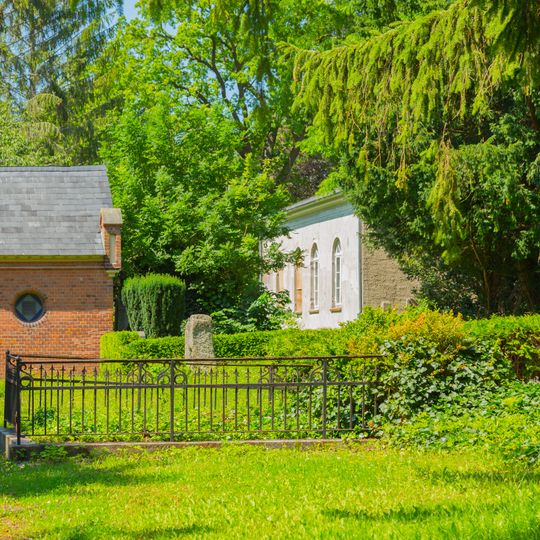
Cemetery of Wismar, Garden monument cemetery in Wismar, Germany.
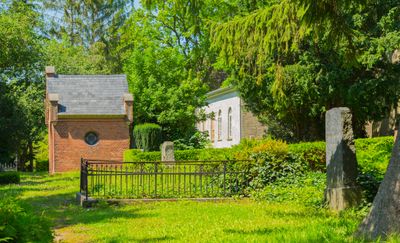
The Cemetery of Wismar is a narrow, east-west oriented burial ground south of the old town, divided by Schweriner Straße into the larger East Cemetery and the smaller West Cemetery. It was laid out from 1832 with landscaping by architect I. G. Borgward and retains old trees. The grounds include the Old Cemetery and 20 individual monuments, such as the Martens Chapel of 1832 and the neoclassical caretaker's house of 1832/33.
On 14 September 1831 Wismar's council and citizens voted to lay out a new cemetery, begun in 1832 south of the old town on ground that had belonged to the town's former fortifications. The gardener's design followed plans by the architect I. G. Borgward. Merchant Johann Gottfried Martens, a member of the cemetery commission, pushed the project and in 1832 built his family's neo-classical mausoleum as the eastern boundary; the chapel followed in the 1940s to designs by Hamburg architect Konstanty Gutschow.
The cemetery holds an Ehrenhain, a memorial grove for fighters for socialism, established in the 1960s. Plaques there commemorate communists Johann Frehse and Ernst Scheel, murdered at Dachau, and KPD chairman Ernst Thälmann, murdered at Buchenwald in 1944. A 1921 stone on the east side honours workers shot defending the republic during the 1920 Kapp Putsch.
The cemetery lies south of Wismar's old town, split by Schweriner Straße: the larger Ostfriedhof is reached via Wiesenweg, the smaller Westfriedhof directly from the road. The grounds run narrow from east to west, so a walk passes the Old Cemetery, the East and the West sections in sequence. The Martens chapel and the 1832/33 caretaker's house stand in the older part.
The cemetery holds 36 forced labourers who died in World War II, buried on the Schweriner Straße side; a 1947 memorial stone on the west cemetery commemorates them. Many had worked in the Triebwagen- und Waggonfabrik or the Dornier aircraft works. A 1921 stone on the east side instead honours workers shot defending the republic during the 1920 Kapp Putsch.
The community of curious travelers
AroundUs brings together thousands of curated places, local tips, and hidden gems, enriched daily by 94,410 contributors worldwide.