St. Wolfgang, Gothic cemetery chapel in Meissen, Germany
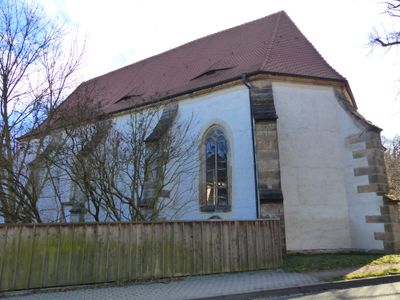
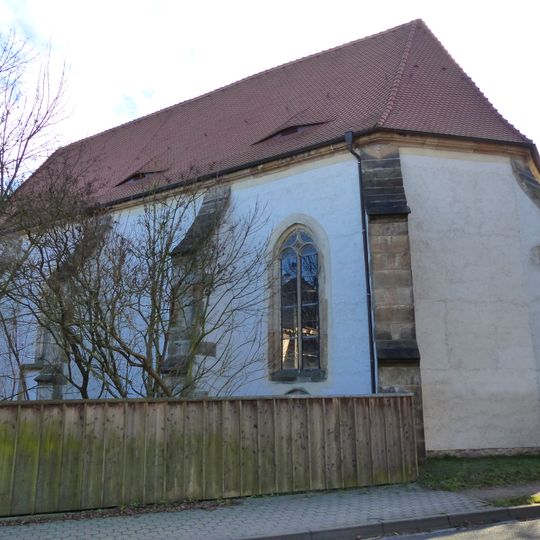
St. Wolfgang is a late Gothic brick chapel in the Obermeisa district of Meissen, surrounded by a cemetery with historic gravestones. Its symmetrical hall plan ends in three-sided polygonal closures at both east and west; two southern annexes, once sacristies, carry ribless star-shaped cell vaults. The photograph shows a steep red-tiled roof with two dark dormer vents, pale walls divided by light-brown stone buttresses, and tall pointed-arch windows with stone tracery.
St. Wolfgang was built in 1471, apparently to plans by Arnold von Westfalen or his circle, and is first documented in 1474. At that time it served as a pilgrimage chapel belonging to the parish church of St. Afra. In later centuries it was used mainly as a cemetery chapel, with minor alterations in 1840. In the early 1990s the St. Afra congregation sold it to the Hochstift Meißen, and after restoration completed in 2004 it became a workshop and store for the Dombauhütte Meißen.
The chapel's name recalls Wolfgang of Regensburg, and in the late Middle Ages it was a pilgrimage chapel belonging to the parish church of St. Afra. Later centuries saw it used mainly as a cemetery chapel, surrounded by historic gravestones. Since the 1990s it has belonged to the Hochstift Meißen, and since restoration ended in 2004 the Dombauhütte has used it as a workshop and store.
St. Wolfgang stands in the Jahnastraße in Obermeisa, west of Meissen's old town, surrounded by a cemetery with historic gravestones. The chapel itself cannot be entered, since the Dombauhütte Meißen uses it as a workshop and storage space. From the street and the cemetery you can see the pale walls, the brown stone buttresses and the steep red tiled roof with its two small dormer vents.
The chapel's organ retains its oldest section, a Brustwerk from the 16th century, which came from the Cistercian convent of Marienstern near Mühlberg and was moved to Pirna in 1547. The Saxon court organ builder Andreas Tamitius enlarged it in 1682; in 1940 the empty case reached St. Wolfgang and received a new seven-register organ by Gustav Steinmann.
The community of curious travelers
AroundUs brings together thousands of curated places, local tips, and hidden gems, enriched daily by 94,534 contributors worldwide.