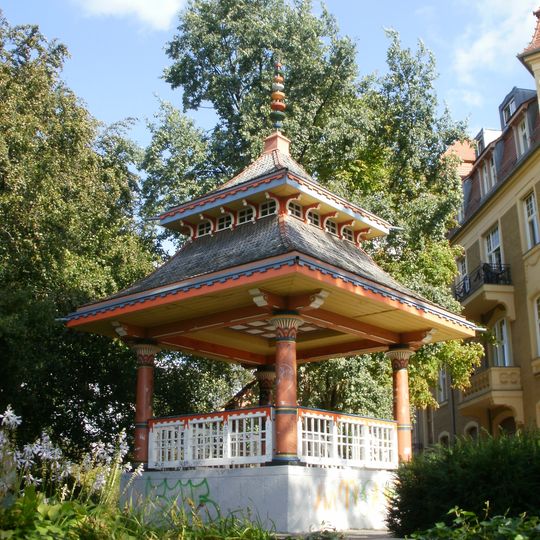
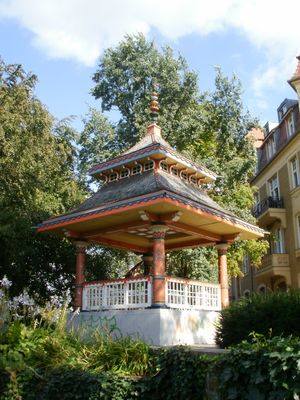
Japanisches Teehäuschen Cottbus, Tea pavilion in Cottbus, Germany
The Japanese Tea House Cottbus is a pavilion with East Asian style standing on a massive base at the northwestern corner of the medieval city wall. The structure features a pagoda-style roof and is supported by four round solid columns that define the interior space.
The building was constructed in 1906 during a period when European cities were drawn to East Asian art forms. It replaced an older defensive tower that previously stood at that location.
The structure shows East Asian architectural forms that reflect how European designers of that era engaged with distant design traditions. Today visitors can see how these aesthetic influences shaped the building's appearance and its role as a landmark in the city.
The building can be viewed from the outside and is easily visible from street level. The structure is straightforward to reach and sits at a notable spot in the old town, making it simple to include in a city walk.
The roof was built using aspen wood, a material that differs notably from typical European roof construction techniques of the era. This choice gives the structure its distinctive appearance and reveals the careful attention paid to authentic East Asian design.
The community of curious travelers
AroundUs brings together thousands of curated places, local tips, and hidden gems, enriched daily by 91,810 contributors worldwide.
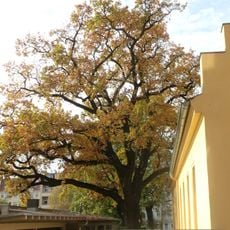
![Naturdenkmal [[Eichen|Eiche]]-[[Stieleiche]] (''Quercus robur'') Mauerstraße/Ecke Bärgasse in Cottbus-Mitte](https://img5.digsty.com/9Ih3TkuLzFXk6Sar-GphRGm-FWtJcRKn_bDBUfGG2rs/rs:fill:230:230:1/g:fp:0.5:0.5/czM6Ly9hcm91bmR1cy8xNC83MTMwMzI4LTE2ODJlZTc5LmpwZw.jpg)
![Naturdenkmal [[Ulmen|Ulme]]-[[Feldulme]] (''Ulmus minor'') Erich‑Kästner‑Platz (ehemaliger Teil von Bahnhofstraße), auf Grundstück vom Piccolo Theater in Mitte](https://img5.digsty.com/foOrkzw9_s5iYyovpgXxdg-9Zc0NPjmwx6kjH3hAoPU/rs:fill:230:230:1/g:fp:0.5:0.5/czM6Ly9hcm91bmR1cy8xNC83MTMwNDU2LWRiYWNjODFkLmpwZw.jpg)
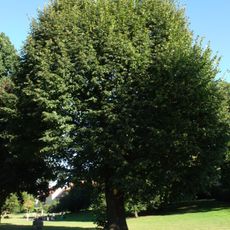
![Naturdenkmal [[Linden (Gattung)|Linde]]-[[Sommerlinde]] (''Tilia platyphyllos'') Klosterplatz in Mitte](https://img9.digsty.com/sUrU75Qu-SFPbnN67eahdbNUAbNWNGlExphkIJ4-uXc/rs:fill:230:230:1/g:fp:0.5:0.5/czM6Ly9hcm91bmR1cy8xNC83MTMwNDkwLTJhODBhMTA0LmpwZw.jpg)
![Naturdenkmal [[Ginkgo]] (''Ginkgo biloba'') Karl‑Marx‑Straße/Ecke Puschkinpromenade in Mitte](https://img7.digsty.com/LQbRwb92dTTZlBsSbAsm1sc1BiEBp6rgnHe52eIyR-M/rs:fill:230:230:1/g:fp:0.5:0.5/czM6Ly9hcm91bmR1cy8xNC83MTMwNDkyLWM2OGM2ZmI1LmpwZw.jpg)