Bui Dam, Hydroelectric power station at Black Volta River, Ghana
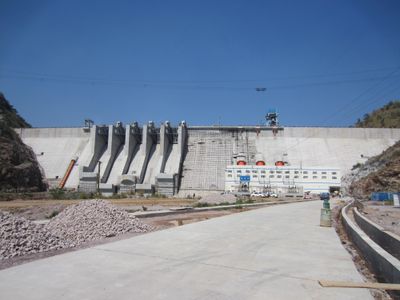
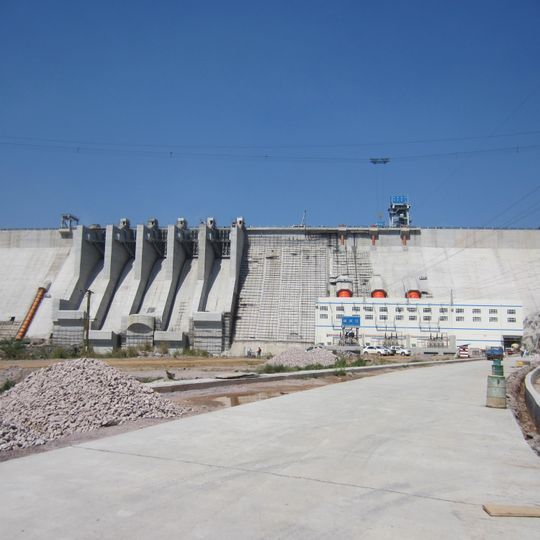
Bui Dam is a 108-metre-high roller-compacted concrete gravity dam on the Black Volta at the Bui Gorge, at the southern edge of Bui National Park. Its crest runs 492 metres and carries gantry structures and three large circular openings with orange rims. A long white building with rows of blue-framed windows stands at the foot of the wall, and two saddle dams lie southwest of the main structure.
Albert Ernest Kitson first proposed a dam at Bui Gorge in 1925. Planning advanced in 1978 with Australian and World Bank support, but four military coups stalled it. Sinohydro began main construction in December 2009; the dam was inaugurated in December 2013.
The reservoir flooded about 20% of Bui National Park, and 1,216 people were resettled from the valley upstream of the dam. Construction employed roughly 3,100 workers, about 500 Chinese and 2,600 Ghanaians, and a strike led to working hours being cut to five days and eight hours. The dam is also meant to supply water to 30,000 hectares of farmland.
The site offers limited public access points and viewing areas from outside the main facility. Visitors should plan their visit during daylight hours and check local conditions, as water levels and surroundings vary by season.
The dam is built to withstand a probable maximum flood with a return period of 10,000 years, according to the French Wikipedia article. Southwest of the main wall, Saddle Dam 1, a rock-fill embankment 500 metres away, keeps pool levels and prevents spillage into other parts of the basin.
The community of curious travelers
AroundUs brings together thousands of curated places, local tips, and hidden gems, enriched daily by 92,825 contributors worldwide.