Hagia Sophia, Byzantine church in center Thessaloniki, Greece
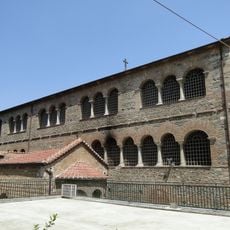
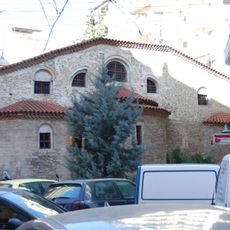
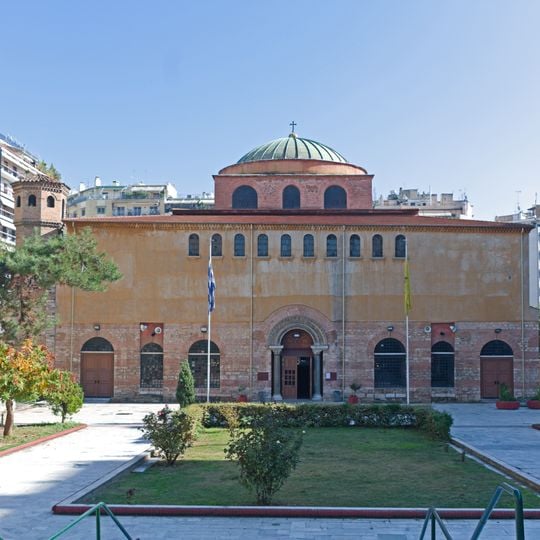
Hagia Sophia is a domed basilica of the 7th century in central Thessaloniki, built on the plan of a Greek cross with the columns of the central nave pulled to the sides. Its tan-yellow upper walls and red brick lower facade carry a shallow ribbed dome on a drum of arched windows, and the entrance is a brick-framed arched portal with a wooden double door and fanlight.
A church stood on this site from the 3rd century; it collapsed in 620, probably from an earthquake, and the present structure was erected later in the 7th century, modelled on Hagia Sophia in Constantinople. In 1205 the Fourth Crusade made it Thessaloniki's cathedral until 1224. After Murad II took the city on 29 March 1430 it became the Ayasofya Camii mosque, and it was reconverted to a church in 1912.
The church celebrates its feast on 14 September, the Exaltation of the Holy Cross. In 1981, the relics of Archbishop Basil of Thessaloniki (9th–10th century) were found behind the stalls of the right choir, as bishops were customarily buried inside cathedrals. The dome mosaic shows the Ascension with the inscription from Acts 1:11, "Ye men of Galilee, why stand ye gazing up into heaven?", ringed by the Twelve Apostles, Mary and two angels.
The building is accessible daily, though visitors should wear appropriate clothing that covers shoulders and knees. It helps to arrive in the morning hours when fewer people are present and the interior lighting is better for viewing.
The dome mosaic shows the Ascension with the inscription from Acts 1:11, "Ye men of Galilee, why stand ye gazing up into heaven?", ringed by the Twelve Apostles, Mary and two angels. In the apse, a plain gold cross from the Iconoclastic era was replaced by the figure of the Theotokos in 787-797.
The community of curious travelers
AroundUs brings together thousands of curated places, local tips, and hidden gems, enriched daily by 94,040 contributors worldwide.