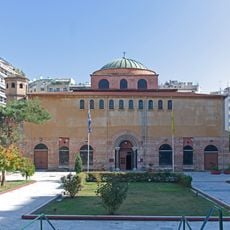
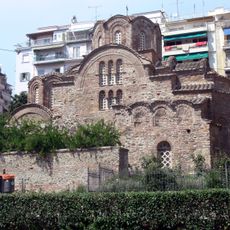
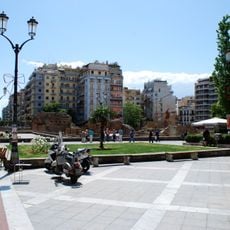
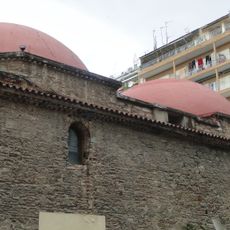
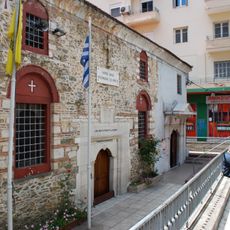
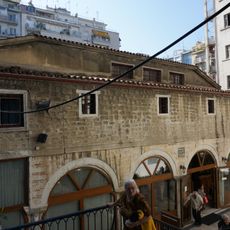
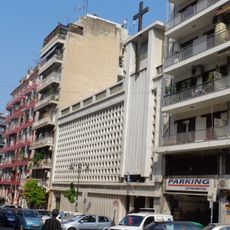
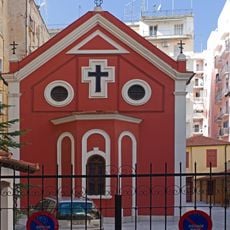
Church of the Acheiropoietos, 5th-century Byzantine basilica in Thessaloniki, Greece
The Church of the Acheiropoietos is a three-aisled basilica with a wooden roof, built around 450–470. Two colonnades of 12 columns each divide the nave from the side aisles, which have galleries above. The tribelon entrance has green Thessalian marble columns, and the central nave preserves its original Proconnesian marble pavement.
Founded in the third quarter of the 5th century, the church was built over a large Roman public bath; a mosaic inscription names the priest Andreas, linked to the bishop at the Council of Chalcedon in 451. In 1430 Sultan Murad II converted it into a mosque, Eski Camii, and an inscription by him survives on the eighth column from the east of the northern colonnade. It remained a mosque until 1912 and was returned to Christian worship in 1930.
The interior displays preserved mosaics showing plants, geometric patterns, and animals from the early Christian era. These decorations reveal the artistic tastes and religious beliefs of the faithful who gathered here centuries ago.
The church is located on Agias Sofias street opposite Makedonomachon square and is open daily. Admission is free, and visitors should wear comfortable shoes since the interior has different floor levels and much of the viewing is done while standing.
The name Acheiropoietos, first attested in a 1320 chrysobull of Emperor Michael IX, refers to a Hodegetria icon of the Virgin believed to be 'not made by hands'. The icon was housed in the church, not formed in its walls. In 1345, Zealots were massacred inside the building.
The community of curious travelers
AroundUs brings together thousands of curated places, local tips, and hidden gems, enriched daily by 94,388 contributors worldwide.