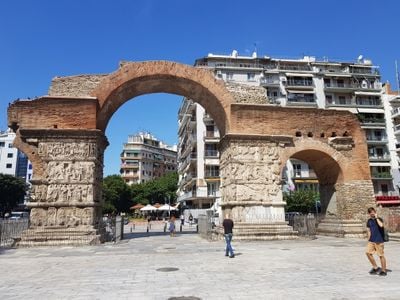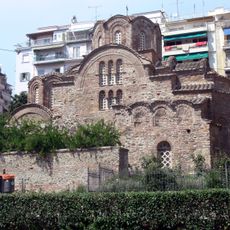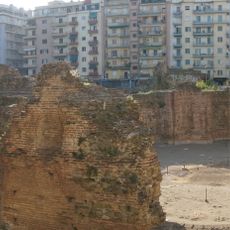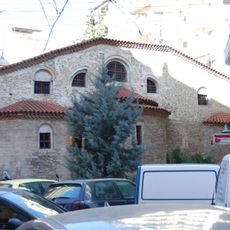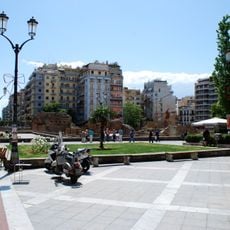
Arch of Galerius and Rotunda, Ancient Roman monument in central Thessaloniki, Greece.
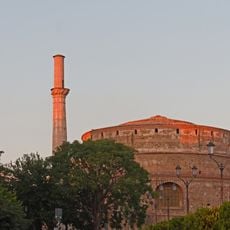
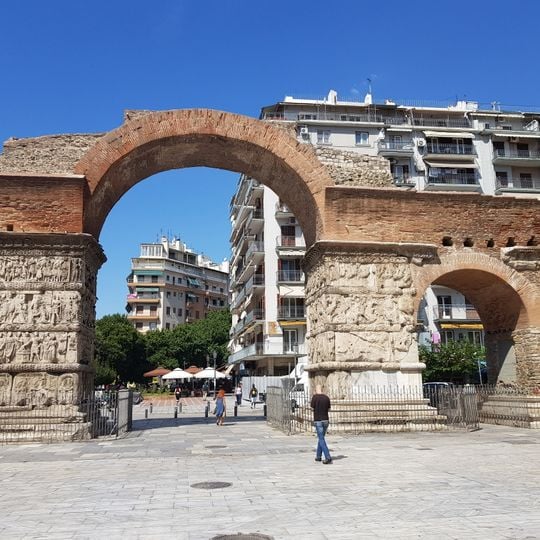
The Arch of Galerius and Rotunda are two early fourth-century monuments in central Thessaloniki. The arch, an octopylon with a central opening 9.7 m wide and 12.5 m high, preserves two marble-faced piers carved with four bands of reliefs showing Galerius's Persian campaigns. The Rotunda, 125 m northeast, is a circular brick structure 24.5 m in diameter with walls over 6 m thick.
Emperor Galerius built this complex between 298 and 305 AD to honor his military victory over the Sassanid Persians. After its original purpose faded, the Rotunda was adapted for religious use first as a church and later as a mosque, reflecting the region's changing rulers and beliefs.
The Rotunda's interior walls display fragments of Byzantine religious mosaics that speak to its transformation from temple to church to mosque over centuries. Walking inside, you can still trace these layers of use in the worn surfaces and decorative remnants left by different faiths.
The site is open to visitors who can walk around freely and view the structures from the outside and interior where accessible. Guided tours are available and help explain the carved panels and the different architectural changes the site has gone through over time.
The arch was an octopylon, an eight-pillared gateway, of which only the northwestern three pillars and parts of the masonry cores above the arches survive. The eastern side and the southernmost western pillar are lost, and the missing pillars' foundations lie beneath the modern pavement. Modern brick consolidation protects the exposed cores.
The community of curious travelers
AroundUs brings together thousands of curated places, local tips, and hidden gems, enriched daily by 93,505 contributors worldwide.