Galerius palace, Roman imperial palace in Thessaloniki, Greece
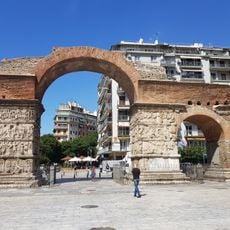
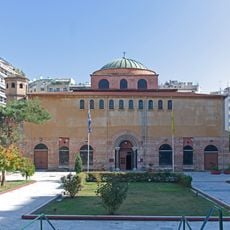
Galerius palace is a Roman imperial complex in Thessaloniki, built from about 298/299 under the Caesar Galerius, who made the city his second capital in the Balkans alongside Sirmium. Its excavated walls stand near Navarinou Square, and the best-preserved structure is an octagon, 30 m across inside, that served as a throne hall or imperial mausoleum and later became a Christian church. The site also held a hippodrome, a basilica and a porticoed courtyard.
Emperor Galerius had the palace built at the start of the 4th century, after choosing Thessaloniki as his residence and the seat of his administration. After his death in 311, the complex gradually lost its imperial function and was partly transformed during the Byzantine period.
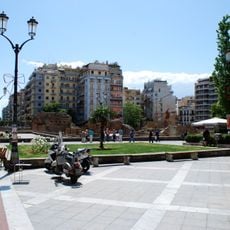
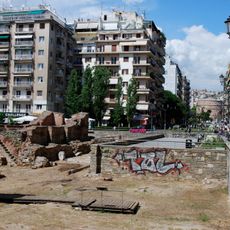
The ruins sit in the middle of the modern city, and visitors can walk along the exposed walls and mosaic floors without leaving the busy streets around Navarinou Square. The contrast between the ancient stonework and the surrounding cafés gives a clear sense of how deeply the Roman past is woven into daily life here.
The exposed remains are open-air and easy to reach on foot around Navarinou Square. Visiting in the early morning allows a closer look at the mosaics and walls before the surrounding square fills up.
The palace was originally connected to a hippodrome whose outline can still be traced in the curved street patterns of the modern neighborhood above it. Some of the marble elements from that hippodrome were later built into the city walls of Thessaloniki, where they can still be seen today.
The community of curious travelers
AroundUs brings together thousands of curated places, local tips, and hidden gems, enriched daily by 94,388 contributors worldwide.