Nea Panagia, church building in Thessaloniki, Greece
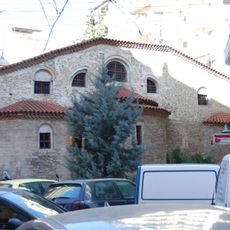
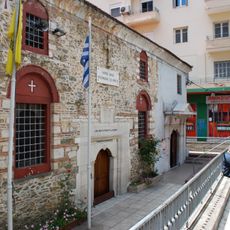
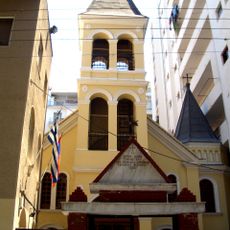
Nea Panagia is a three-aisled basilica with a gallery, built in 1727 as recorded on a marble plaque above the south door. A portico runs along the west side, while a later neoclassical porch with a bell tower stands on the south; the tower was rebuilt after the 1978 earthquake. Inside, 18th-century murals in the Palaeologan style cover the sanctuary and gallery, alongside a gilded carved wooden iconostasis, a 19th-century bishop's throne, pulpit and ceiling paintings.
Archaeological finds point to a 12th-century Byzantine monastery of the Theotokos on this site; the French traveller R. de Dreux recorded it in 1666, and it burned down in 1690. The present church was built in 1727, as a marble inscription above the south door states, and its wall paintings are attributed to David Selenica. The bell tower above the south portico was damaged in the 1978 earthquakes, demolished and rebuilt.
The church is named after the Virgin Mary and continues a long tradition of Marian devotion in Greece. Today, worshippers light candles before the icons and gather here for prayer, keeping these religious customs alive within its walls.
The church is located near Tsimiski and Metropolis streets in the southeastern center of Thessaloniki and is easily accessible on foot. Visitors should wear modest clothing and maintain quiet, as this is an active place of worship with simple, peaceful interior spaces.
The icon of the Virgin Mary Glykophilousa in the church is the work of the painter Ioannis Papatalasiou. The 18th-century murals inside, in the sanctuary and the gallery, follow the models of Palaiologan painting. The marble inscription above the south door records the year 1727.
The community of curious travelers
AroundUs brings together thousands of curated places, local tips, and hidden gems, enriched daily by 94,390 contributors worldwide.