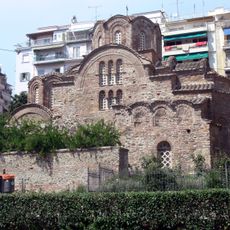
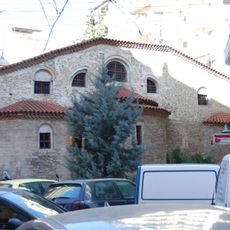
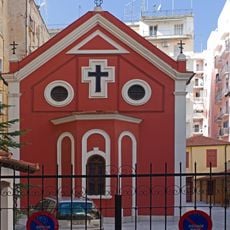
Panagia Dexia, Thessaloniki, Greek Orthodox church near Arch of Galerius, Thessaloniki, Greece
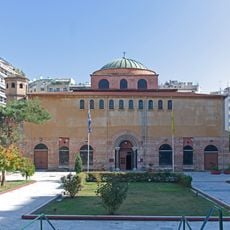
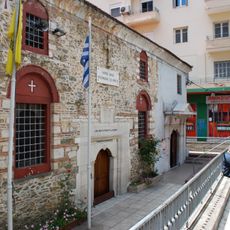
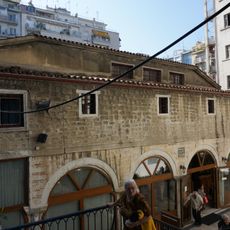
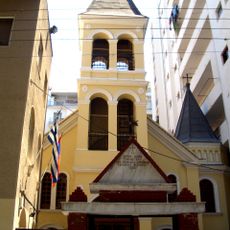
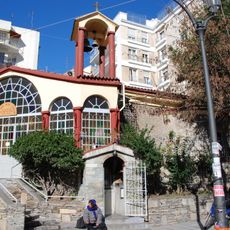
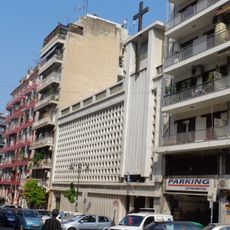
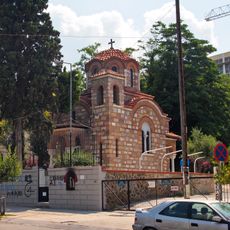
Panagia Dexia is a parish church of the Metropolis of Thessaloniki on Egnatia Street, at number 155, in the Kamara district. It is a cross-in-square church with a dome and two bell towers. It replaced the small three-aisled basilica of Saint Ipatios, which stood on the same site.
A church existed on this site since Byzantine times: the Megali Panagia is documented in 1542 and 1546 and in two 14th-century manuscripts. Under Ottoman rule a church dedicated to Saint Hypatius stood here, built in 1727 according to Vasilis Dimitriadis (1818 per metropolis documents, as a gift of the Chalkidiki monastery of Saint Anastasia). The foundation stone of the present church was laid on 4 November 1956 by Metropolitan Panteleimon I, and it opened on 20 July 1976 under Panteleimon II, renamed after the wonderworking icon kept in Saint Hypatius.
The painted walls and icons inside show how the Virgin Mary is venerated in Greek Orthodox tradition and guide people in their daily prayers. Visitors observe locals lighting candles and spending quiet moments in front of these sacred images.
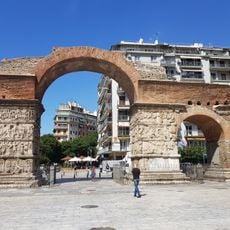
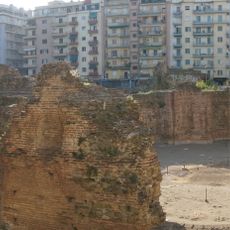
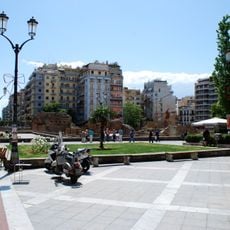
The church stands at Egnatia 155, in the Kamara area of the city centre, on the same street as the Arch of Galerius. The entrance is on the side street Panagia Dexia, named after the church itself. Visitors arriving by bus or metro stop within walking distance in the centre.
The epithet "Dexia" means "Right" or "she who receives": the Thessaloniki writer Nikos Gabriel Pentzikis, in his book Mother Thessaloniki, describes the Virgin as Dexa, an intermediary who accepts the petitions of the faithful. The wonder-working icon that gave the church its name was kept in the older church of Saint Ipatios on the same site.
The community of curious travelers
AroundUs brings together thousands of curated places, local tips, and hidden gems, enriched daily by 94,388 contributors worldwide.