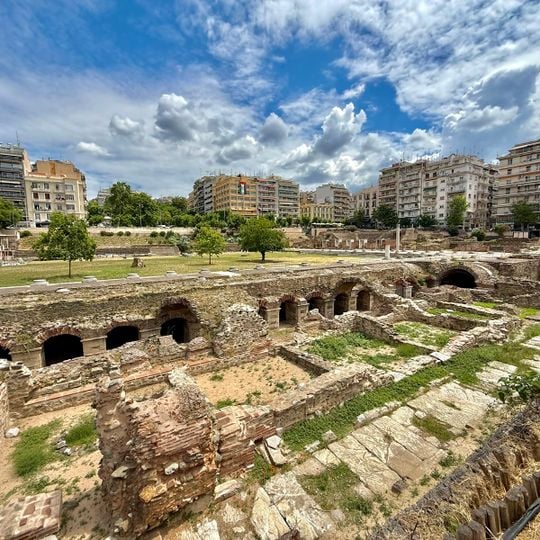
Roman Agora of Thessaloniki, Ancient marketplace ruins in central Thessaloniki, Greece
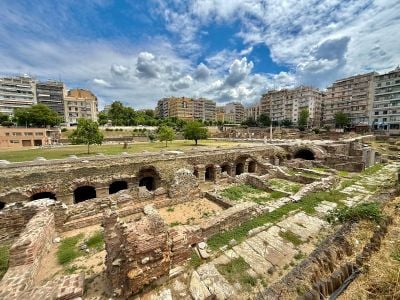
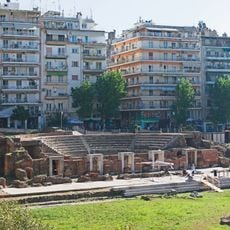
The Roman Agora of Thessaloniki is an ancient marketplace that spans multiple levels connected by stone staircases and defined by columns, covered porticoes, and paved squares. The site displays the characteristic layout of a Roman forum with spaces designed for commerce and public assembly.
The Roman Agora was laid out at the end of the 2nd century and in the first third of the 3rd century AD, modelled on the centre of Rome rather than on an earlier Macedonian market. It stood at the crossing of the Via Regia (today's Egnatia Street) and a north–south avenue linking the sea to the acropolis, and served as the city's administrative centre for about three centuries. In the early Christian period it was altered but kept some of its functions as a social centre.
The odeon in the eastern part had built stone tiers and a stage; it now hosts cultural events. In late antiquity the Cryptoporticus was turned into a large water reservoir, and a healing holy-water spring was set up in part of the same stoa, where an important early Christian wall painting was found.
The site is located in the city center and is easily accessible on foot from Thessaloniki's main streets. The remains are partly exposed and partly surrounded by modern buildings, so exploring from multiple approaches helps you understand the full layout.
Hidden beneath the southern colonnade lies a cryptoporticus, an underground passage that sheltered people from bad weather while supporting the upper level. This concealed engineering reveals how Romans designed practical solutions into their public spaces.
The community of curious travelers
AroundUs brings together thousands of curated places, local tips, and hidden gems, enriched daily by 94,296 contributors worldwide.