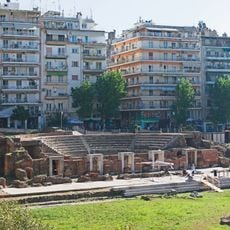
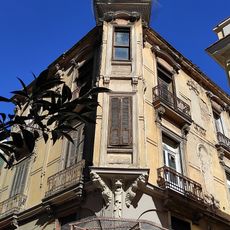
Kapani, Traditional marketplace in central Thessaloniki, Greece
Kapani, also called Agora Vlali, is the oldest traditional market in Thessaloniki, bounded by Egnatia, Aristotelous, Ermou and Venizelou streets. Its two-storey buildings house fishmongers, butchers, greengrocers, bakeries, pastry shops and olive sellers, alongside traditional coffee houses and shops selling souvenirs and clothing. Some of its pedestrian lanes are covered.
The market existed by the late 15th century as part of the Vayazit II vakıf, and a 1569 Ottoman land register records a Lavra monastery metochion in the "Un Kapan" quarter. After the Greek Revolution began in May 1821, Bishop Meletios of Kitros and notables including Christodoulos Balanos, Christos Menexes and Anastasios Kydoniatis were executed here on 21 July 1821. Fires struck in 1889, 1896, 1898 and 1917; after 1917 the Jewish community was barred from rebuilding its synagogues.
The name derives from the Ottoman "Un Kapan", a flour market and weighing station; older documents also call it Kapan-ı Galle. The 1569 Ottoman land register records a Lavra monastery dependency here with a candle workshop, wine shop and three-room konak. The name Vlahi Market was given in the early 1930s, when streets were renamed after 1821 revolutionaries.
The market is most busy in early morning hours and quieter by midday, so timing your visit makes a difference. Wear comfortable shoes since the pathways are narrow and sometimes wet.
The name Kapani comes from the Ottoman Turkish "Un Kapan", meaning flour market, from un (flour) and kapan (scales). Ottoman records call it Kapan-ı Galle, and a 1569 Ottoman land register notes that the Lavra monastery of Mount Athos held a metochion in the "Un Kapan" quarter, with candle workshops, a wine shop and a three-room konakion.
The community of curious travelers
AroundUs brings together thousands of curated places, local tips, and hidden gems, enriched daily by 93,870 contributors worldwide.