Lerna, Archaeological site in Myloi, Greece
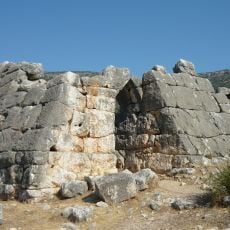
Lerna is an archaeological site near the village of Myloi in the Argos-Mykines municipality, Greece. It occupies one of the largest prehistoric mounds in Greece, about 180 by 160 metres, formed over a long Neolithic occupation. On its levelled crest stands the Early Helladic II settlement of Lerna III, ringed by a double defensive wall with towers and containing the two-storey House of the Tiles, named for its terracotta roof tiles.
The settlement began in the Neolithic period and reached its height during the early Bronze Age, when inhabitants built fortified walls and a large public building. After destruction around 2200 BCE, the area was resettled and remained occupied into the Mycenaean period, with later generations covering the monumental structure with an earthen mound.
Lerna was one of the entrances to the Underworld, and the Lernaean Mysteries sacred to Demeter were held there, along with a festival called the Lernaea. Pausanias credits Philammon, twin of Autolycus, with founding the mysteries. Dionysus was invoked here as Bugenes, "son of the Bull", to the sound of an archaic trumpet called a salpinx, while a lamb was cast into the waters for the Hydra, keeper of the gate.
The site lies near the village of Myloi, south of Argos, on a low mound between the mountains and the Argolic Gulf. The ground is uneven and partly covered with loose stones, so sturdy footwear helps. The surrounding area was once marshy; the former lake was drained in the 19th century.
The site's excavator, John L. Caskey, began work in 1952 and launched the publication series Lerna I–V on its Bronze Age finds. Banded patterns stamped with the very same seal have turned up at Lerna, Tiryns and Zygouries, linking these settlements through a shared marking system.
The community of curious travelers
AroundUs brings together thousands of curated places, local tips, and hidden gems, enriched daily by 94,072 contributors worldwide.