Elliniko pyramid, Ancient pyramid in Elliniko, Greece.
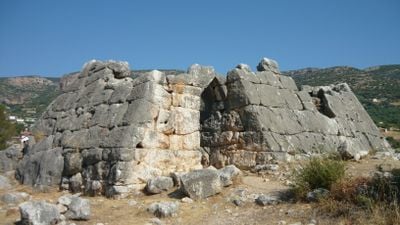
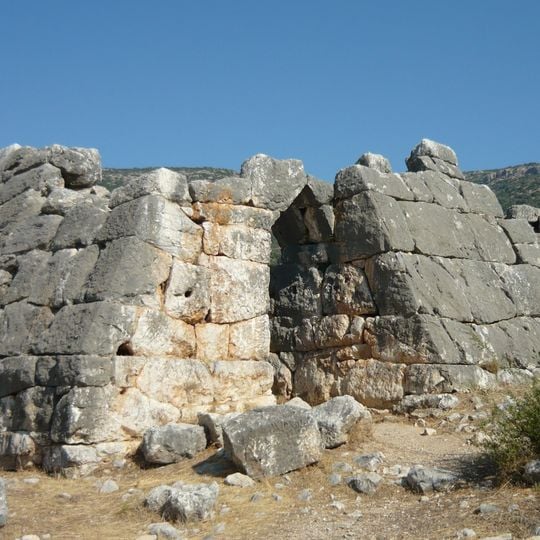
The Elliniko pyramid is an ancient limestone structure in the Argolida region. The building has a rectangular base with walls that rise at a steep angle and end flat on top, with a corridor leading into the interior.
Pausanias in the 2nd century AD described a pyramid-like building on the Argos–Epidauria road, decorated with Argive shields and held to be the common tomb of Proetus and Acrisius's fallen followers. Excavation by Theodor Wiegand around 1900 and by L. Lord in 1937 found Early Helladic II ceramics and later Classical and Roman material. Thermoluminescence dating by Ioannis Liritzis in 1991 gave c. 2500–2000 BC, a result disputed by Mary Lefkowitz.
Pausanias, writing in the 2nd century AD, described a pyramid-like building on the Argos–Epidauria road decorated with Argive shields in relief, which he took to be the common tomb of Proetus and Acrisius's fallen followers. The surrounding district was called Pyramia after these monuments. The name Hellinikon comes from the modern village beside the structure.
The structure stands in open, dry ground with low vegetation at its base, at the southeastern edge of the plain of Argos near the springs of the Erasinos at Kefalari. It lies on the line of the ancient road from Argos to Tegea, so it is reached from the Argos side; there is no sea view, the sea being well away from the plain. The masonry is broken and uneven, so watch your footing around the base.
Unlike Egyptian pyramids, a narrow passage enters from the southeast side into the structure's interior. This passage opens into a large square room, suggesting a completely different purpose than the famous Egyptian tombs.
The community of curious travelers
AroundUs brings together thousands of curated places, local tips, and hidden gems, enriched daily by 93,131 contributors worldwide.