Monastery of the Holy Trinity, Meteora, Orthodox monastery in Meteora, Greece
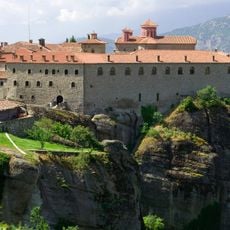
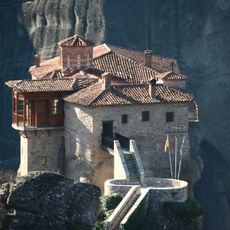
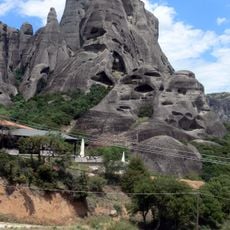
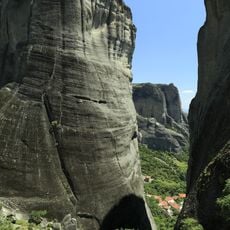
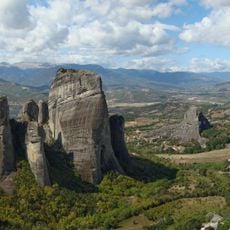
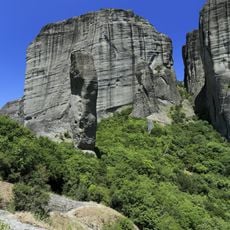
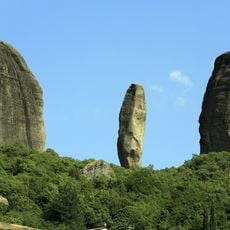
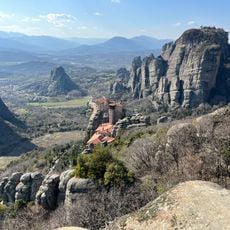
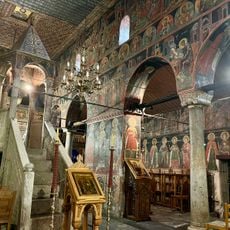
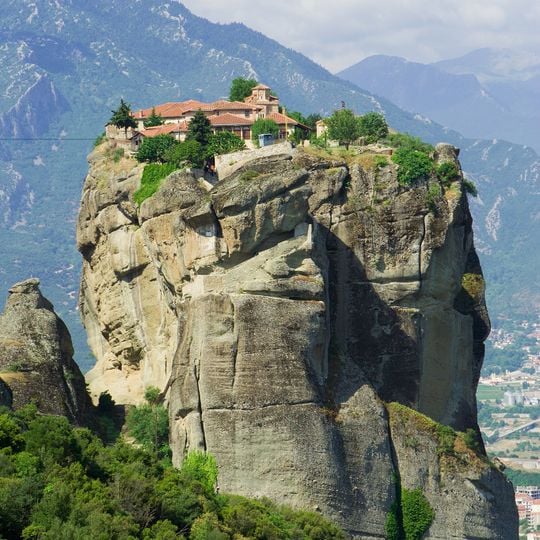
The Monastery of the Holy Trinity occupies the flat summit of a grey and tan rock pillar over 400 metres high, its light-walled buildings roofed in red tiles. The cruciform church has a dome carried on two columns, a pseudo-trefoil window in the apse, and frescoes painted in 1741. A stone archway on the left leads to an enclosed terrace with a low wall; a wooden balcony projects from a tiled overhang.
The monk Dometius is named in local legend as the founder, arriving at the rock in 1438, while many sources date the monastery's construction to 1475–1476; the adjoining chapel of St. John the Baptist has no recorded construction date. The main cathedral was built in the 15th century and its frescoes were painted in 1741 by two monks. A skeuophylakion was added in 1684 and the esonarthex barrel vault in 1689, embellished in 1692.
The monastery is named for the Holy Trinity, Agia Triada in Greek. Its katholikon holds frescoes painted in 1741 by two monks, and the rock-cut chapel of St. John the Baptist keeps 17th-century frescoes, including one of St Sisois before the skeleton of Alexander the Great. The chapel's manuscripts and treasures were looted during the German occupation in World War II.
The final approach runs through tunnels cut in the rock and up 130 stone steps, so wear shoes with grip. A winch-operated lift and a road from the back of the cliff also reach the summit. The 0.8-hectare garden on top offers shade after the climb.
This site served as a filming location for a major spy film in 1981, which introduced it to audiences worldwide and created lasting recognition. The film connection continues to draw visitors who recognize the dramatic rock setting from cinema.
The community of curious travelers
AroundUs brings together thousands of curated places, local tips, and hidden gems, enriched daily by 92,818 contributors worldwide.