Tower of the Winds, Ancient clock tower in Roman Agora, Athens, Greece
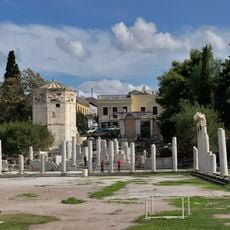
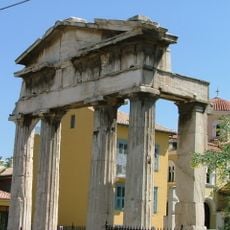
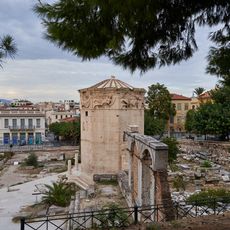
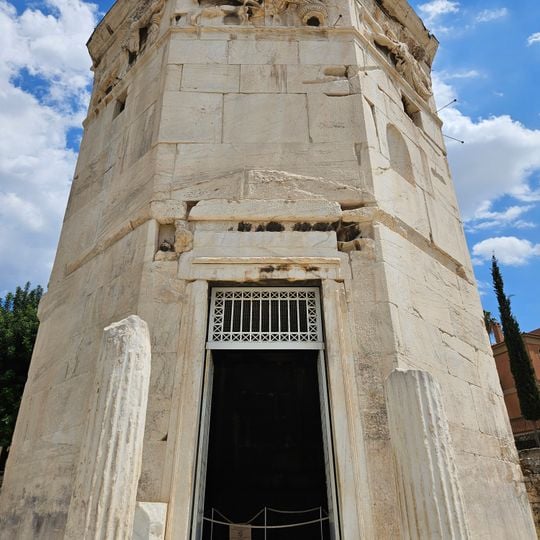
The Tower of the Winds is an octagonal structure made of Pentelic marble that rises about 12 meters above the Roman Agora. The building displays eight elaborately carved wind deities on its sides and once housed a sophisticated timekeeping system fed by underground water channels.
Built by the Macedonian astronomer Andronicus of Cyrrhus in the first half of the 1st century BC, the tower was already cited by Varro around 37 BC. In early Christian times it served as the bell tower of a Byzantine church. After the Ottoman reconquest of Athens it became a tekke of dervishes, who stayed until 1821 and whose presence protected it from looting; it was fully excavated in the 19th century.
Each of the eight sides carries a relief of a winged wind god, with its name carved below the cornice: Boreas, Kaikias, Apeliotes, Eurus, Notus, Livas, Zephyrus and Skiron. Below each figure, incised lines formed a sundial. The neighbourhood around the tower is still called Aerides, "the Winds".
The monument lies about five minutes on foot from Monastiraki Square and is easily reached by following signs through the Roman Agora. The best time to visit is early morning or evening, when fewer visitors are present and the light brings out the stonework details more clearly.
The tower's eight sundials are carved directly into the marble below each wind relief, with inscribed rays forming the dials. The roof of 24 trapezoidal stone slabs, held by a circular keystone and carved to imitate tiles, is essentially original. Inside, eight small columns under four feet high stand at the corners of the octagon.
The community of curious travelers
AroundUs brings together thousands of curated places, local tips, and hidden gems, enriched daily by 92,821 contributors worldwide.