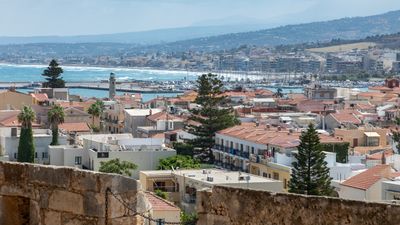
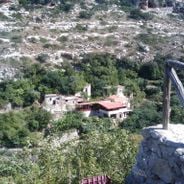
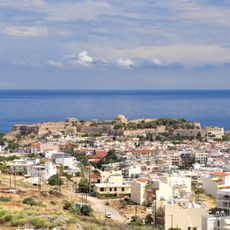
Fortezza of Rethymno, Stone fortress overlooking the Mediterranean Sea in Rethymno, Greece.
The Fortezza of Rethymno is a stone fortress built on a hill with thick limestone walls and multiple bastions. The structure has several gateways and encloses areas containing buildings and a theater inside.
The fortress was built between 1573 and 1580 by engineers serving Venice to protect the harbor town. Ottoman forces captured it in 1646 and later modified its structure.
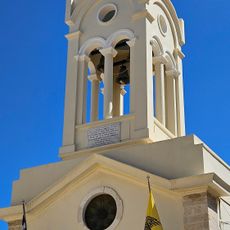
The name Fortezza comes from the Italian word for fortress, used during Venetian rule; Greeks also call such a fort a frourio or kastro. The former Cathedral of St Nicolas became the Mosque of Sultan Ibrahim under the Ottomans, and the building beside it may have been the bishop's residence. The Erofyli open-air theatre on St Elias Bastion opened in 1993.
Enter through the main gate on the southeast side, reached by a 26.8 m vaulted passage; the west and north auxiliary gates are closed. The outer wall is 1,307 m long and up to 1.74 m thick, with ten round watchtowers along the parapet. The Archaeological Museum of Rethymno occupies the Ottoman ravelin in front of the entrance.
The Mosque of Sultan Ibrahim was converted from the Cathedral of St Nicolas after the Ottoman capture of 1646. The Ottomans otherwise left the fortress largely unchanged, adding only a ravelin outside the main gate; that five-sided structure served as a prison until the 1960s and has housed the Archaeological Museum of Rethymno since 1991.
The community of curious travelers
AroundUs brings together thousands of curated places, local tips, and hidden gems, enriched daily by 92,913 contributors worldwide.