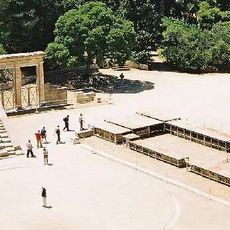
Sanctuary of Apollo Maleatas, Archaeological site on Mount Kynortion, Greece
The sanctuary of Apollo Maleatas occupies a low hill on Mount Kynortion, east of the Asklepios sanctuary at Epidaurus. Its remains include a small 4th-century BC Doric temple of Apollo, a monumental altar, a stoa of the late 4th century BC, Roman baths, a Roman fountain and gateway, an underground cistern, a shrine of the Muses and staff quarters.
The hilltop held an Early Helladic settlement, abandoned by 2000 BC; cult activity began in the Late Bronze Age with an open-air ash altar receiving bronze double axes, swords and clay figurines. After a Geometric revival, a temple stood by around 550 BC, replaced around 380 BC by the classical Doric temple. Around 80 BC Cilician pirates may have sacked it; in the 2nd century AD the senator Antoninus of Nysa rebuilt the sanctuary.
According to the hymn of Isyllos of Epidauros, the cult was founded by a certain Malos, from whose name the epithet Maleatas derives; J.W. Riethmüller instead links the name to Cape Maleas. Apollo was worshipped here as a healing god, and by the late 7th century BC the type of votive offerings changed, suggesting Asklepios was then honoured too. A second sanctuary of Apollo Maleatas stood in Sparta.
The sanctuary lies on the slope of Mount Kynortion above the Asklepieion of Epidaurus, reached on foot over uneven ground. Excavation and restoration of the ancient walls have continued since 1995 and through the 2010s, and the site is not yet formally open to the public, so access should be checked locally before setting out.
This place represented one of the earliest connections between religion and medicine in the ancient world. Sick people traveled from distant places hoping the god would cure them, turning the sanctuary into an ancient healing destination before hospitals existed.
The community of curious travelers
AroundUs brings together thousands of curated places, local tips, and hidden gems, enriched daily by 94,547 contributors worldwide.