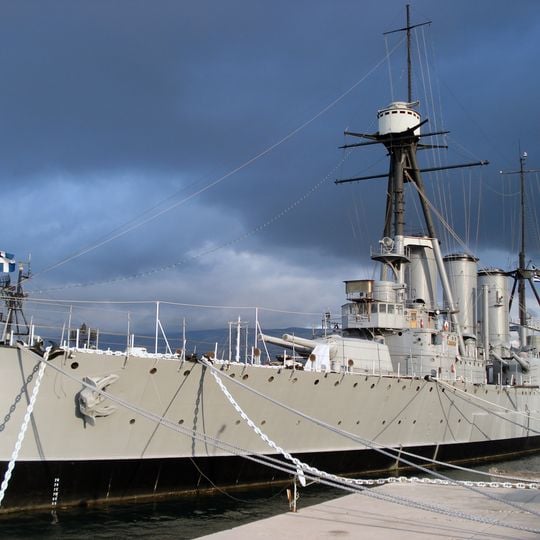
Georgios Averof, Maritime museum ship in Palaio Faliro Municipality, Greece
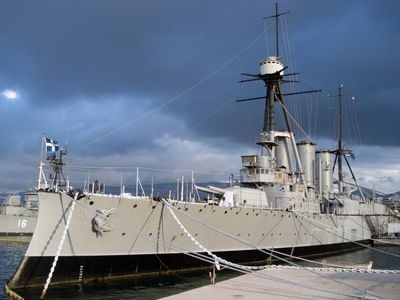
Georgios Averof is a Pisa-class armored cruiser built at Livorno's Orlando shipyard and launched on 12 March 1910, now moored as a museum ship at the Naval Tradition Park in Palaio Faliro. Its light grey hull carries a black band at the waterline, three tall funnels amidships behind a mast with a white drum-shaped top, rows of small dark portholes, and an anchor at the bow. Six gun turrets with rounded, pillbox-form housings held its British-built Armstrong guns; the stern has a balcony and an ornate nameplate with the coat of arms of the Kingdom of Greece.
Built in Livorno between 1908 and 1911, the cruiser led Greek fleet operations during the First Balkan War and contributed to control of the Aegean. After the end of its active service, the ship opened as a floating museum in 1984.
Greeks nicknamed the ship "Lucky Uncle George" (Τυχερός μπάρμπα-Γιώργος), while the Ottoman fleet called it "the Devil Ship" (Σεϊτάν παπόρ) after it broke their line at Elli and Lemnos. Its name comes from Georgios Averof, whose 1899 will left a fifth of his estate to the Navy Fund for a warship bearing his name, to serve as a training ship and naval cadet school. A small Orthodox chapel to Saint Nicholas, patron of sailors, sits inside a space first meant for ammunition.
The ship lies near Athens and offers tours in several languages, with an elevator available for guests with limited mobility. Visitors should wear sturdy footwear, as some decks have steep stairs and metal steps.
The ship's stern carries a balcony recalling the wooden sailing ships of the Greek War of Independence, and a steel ram on the inverted bow echoes ancient triremes. A small Orthodox chapel to Saint Nicholas, patron of sailors, occupies a space first designed as an ammunition store.
The community of curious travelers
AroundUs brings together thousands of curated places, local tips, and hidden gems, enriched daily by 92,777 contributors worldwide.