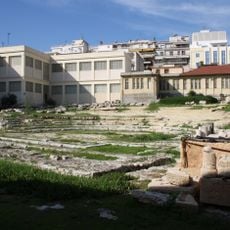
Siraggion, Archaeological cave site in Kastella, Piraeus, Greece
Siraggion is a natural cave and underground passage cut about 12 metres into the rock of Kastella's eastern slope in Piraeus, beneath the coastal Vasileos Pavlou avenue, above Votsalakia beach. Its circular hall holds mosaics from the 4th century BC: one shows Scylla, the other a young man in a four-horse chariot. Two ancient tombs and a shaft stand near the entrance.
Siraggion was discovered in 1897 on the east side of Kastella, above the sea at today's Votsalakia. Structures are attributed to prehistoric Minyans of Ionian origin who settled there from Orchomenos in Boeotia. In the 4th century BC the site belonged to Euktemon, who sold it to Antiphanes and Aristolochos for 3,000 drachmas, as Isaeus records. Mosaics show alterations in the Roman period.
The cave's name comes from the hero Serangos, who according to Photios built it and was honoured by a heroon inside. In the 1920s it was fitted out as a seaside taverna, and the owners covered the ancient wall paintings with wine barrels. In the 1960s it became a laïko music venue called "Spilia", where Manolis Chiotis, Mary Linda and Grigoris Bithikotsis performed.
The cave lies on the rocky coast below Vasileos Pavlou Avenue in Votsalakia, east of Kastella in Piraeus. It is reached on foot from the Piraeus centre or from the tram stop; the entrance is easy to miss. The site is abandoned, so bring a torch and watch for uneven ground.
In 1968, mayor Aristidis Skylitsis shut down the "Spilia" music venue that had operated in the cave since the 1920s; Manolis Chiotis, Mary Linda and Grigoris Bithikotsis had performed there. The owners had covered the ancient wall paintings with wine barrels.
The community of curious travelers
AroundUs brings together thousands of curated places, local tips, and hidden gems, enriched daily by 94,658 contributors worldwide.