Apidima Cave, Archaeological cave on the Mani Peninsula, Greece
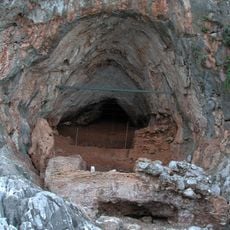
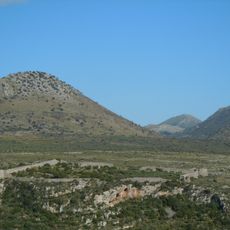
Apidima is a cave on the western coast of the Mani peninsula, formed from several chambers created by limestone weathering. It sits just a few meters above sea level between two bays in a steep rock face.
Scientific research at Apidima began in 1978 under Theodore Pitsios, run by the National Archaeological Museum of Greece with Athens and Thessaloniki universities. That year two crania were recovered from a breccia layer 4 m above sea level in Cave A, labelled Apidima 1 and Apidima 2. Uranium-thorium dating published in 2019 put Apidima 2 at over 170,000 years, with Neanderthal morphology, and Apidima 1 at over 210,000 years.
The name Apidima comes from the Greek word for the site, Spilaio Apidima, and the caves open in a limestone sea cliff on the west shore of the Mani Peninsula. The complex is designated as caves A, B, C and D, and stone tools were found in all four. The two hominin crania, Apidima 1 and Apidima 2, were uncovered in Cave A in 1978 and are now held by the National Archaeological Museum of Greece.
The caves open in the face of a large sea cliff on the west shore of the Mani Peninsula and are reachable only by boat; there is no coastal path to walk in. The entrance sits at the waterline, so landing depends on calm sea and the boat operator's judgement. The hominin fossils came from Cave A, about 4 m above sea level.
The two hominin skulls, Apidima 1 and Apidima 2, were found in 1978 in Cave A, embedded in breccia about 4 m above sea level. Uranium-thorium dating published in 2019 gave Apidima 2 a Neanderthal morphology and an age of more than 170,000 years, while Apidima 1, with a mixture of modern and primitive features, was dated to more than 210,000 years.
The community of curious travelers
AroundUs brings together thousands of curated places, local tips, and hidden gems, enriched daily by 93,207 contributors worldwide.