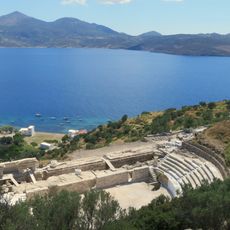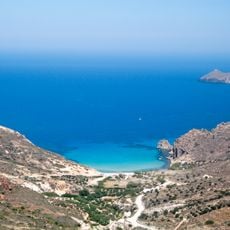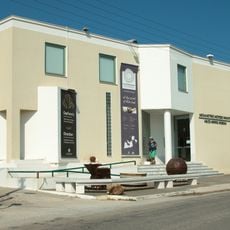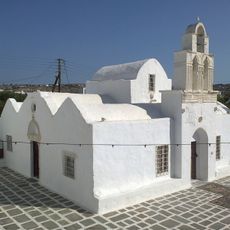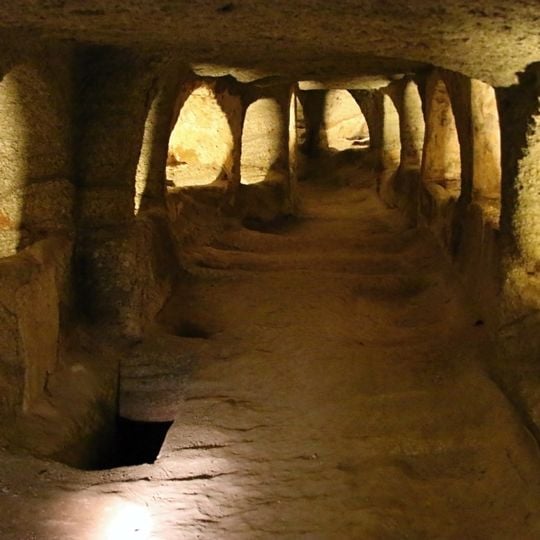
Catacombs of Milos, Early Christian burial site in Milos, Greece.
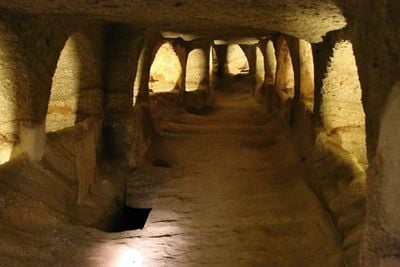
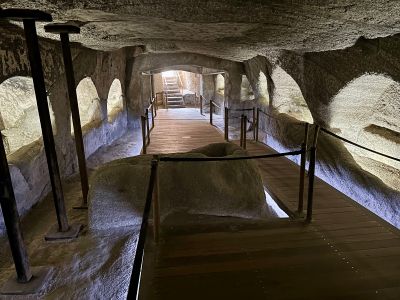
The Catacombs of Milos are an underground Christian cemetery cut into soft volcanic tuff on a hillside southwest of Trypiti. Their corridors total about 200 metres in length, between 1 and 5 metres wide and 1.6 to 2.5 metres high, with arched and horizontal tombs carved into the walls and pit graves sunk into the floor under irregular stone slabs. George Sotiriou distinguished three sections, A, B and C, later joined by passages; visitors now enter through section B.
The Catacombs of Milos were a communal cemetery in use from the 1st to the 7th century AD, according to excavation finds of 2007-2009. The German archaeologist Ludwig Ross, who visited in 1844, counted 1,500 to 2,000 tombs holding 7,000 to 8,000 people; in 1878 Charles Bayet estimated 300 tombs and at most 1,500 burials. Use ended in the 7th century, when earthquakes and raids struck the island.
The name Trypiti comes from the holes (trypes) cut into the porous volcanic rock around the site, still used today as storerooms and stables. Inscriptions in the catacombs are in Greek and carry Greek names such as Alexandros, showing the cemetery served the local population. Since 2002 one tomb served yearly as an altar on All Saints' Day, with a plexiglass cross placed on it until its removal in the late 2000s.
The site is only accessible in certain sections, and visitors should stick to designated paths. Walking through these ancient corridors requires some care, so appropriate footwear is important.
A clay lamp bearing Jewish symbols was found in the 2007–2009 excavation, alongside pottery imported from Asia Minor, Cyprus and North Africa. The inscriptions that survive are in Greek and carry Greek names such as Alexandros, which points to use by the local population rather than by settlers from Palestine.
The community of curious travelers
AroundUs brings together thousands of curated places, local tips, and hidden gems, enriched daily by 93,962 contributors worldwide.