Lefkadia Judgment tomb, Macedonian tomb in Lefkadia, Greece
The Tomb of Judgement in Lefkadia has a monumental facade 8.68 m wide and 8.6 m high, with four Doric columns below and six Ionic columns above. Behind it lie two barrel-vaulted chambers: an antechamber 6.5 m wide and 7.7 m high, and a smaller burial chamber with red walls and white stucco pilasters.
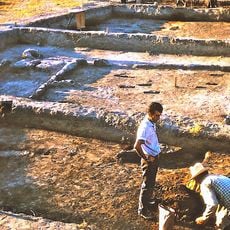
Built probably at the start of the 3rd century BC, the tomb was covered by an earthen tumulus about 10 m across and 1.5 m high, removed during excavation. Roadworks in 1954 revealed it, and Photis Petsas excavated it from 1954 to 1964. Liana Stefani re-excavated and restored it in 1998; finds are kept in the Archaeological Museum of Veroia.
The tomb's name comes from the painted scene on its facade, a rare subject in ancient Greek art: the dead man led by Hermes to be judged in Hades. The warrior is shown with Hermes Psychopompus, while Aeacus and Rhadamanthys, two of the three judges of the dead, are labelled with inscriptions above them.
The site is located in the Naousa Municipality and functions as an open archaeological area where visitors can see the structure and surrounding dig zones. To understand the artifacts and their context, you may want to visit the nearby Archaeological Museum of Veroia which holds many of the finds from this location.
The facade's lower half carries four painted figures: a warrior, Hermes Psychopompus, and the judges Aeacus and Rhadamanthys, the latter two named in inscriptions above them. The scene shows the deceased being led to judgement in Hades, the source of the tomb's name.
The community of curious travelers
AroundUs brings together thousands of curated places, local tips, and hidden gems, enriched daily by 92,913 contributors worldwide.