Théâtre des Variétés, Cultural theatre in 2nd arrondissement, France
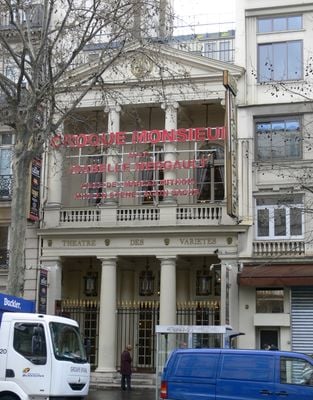
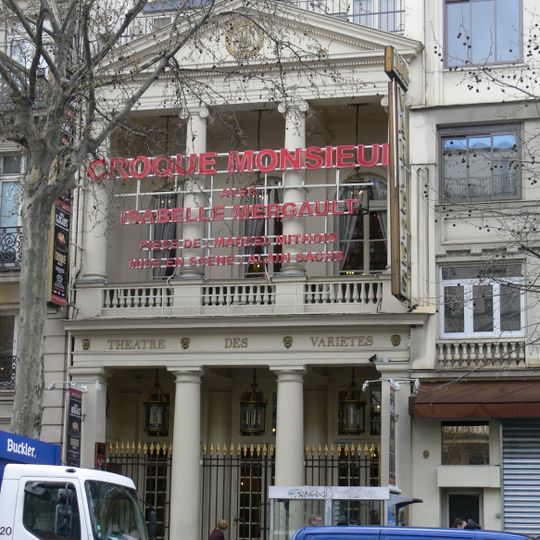
Théâtre des Variétés stands at 7 boulevard Montmartre, its light stone facade carrying a projecting portico: four smooth columns below a raised balcony with a stone balustrade, where red capital letters spell CROQUE MONSIEUR, AVEC ISABELLE MERGAULT, PIECE DE MARCEL WITHOIS, MISE EN SCENE JEAN SACHS. Carved under the entablature, THEATRE DES VARIETES flanks small ornamental faces; a wrought-iron gate with gilt finials and hanging lanterns closes the ground level.
Constructed in just five months following Napoleon's approval, the theatre opened on June 24, 1807. Mademoiselle Montansier had petitioned the Emperor directly for authorization to build this new venue.
The theatre's name comes from the variety shows it staged, and its repertoire shifted in 1864 when Offenbach premiered La Belle Hélène there, followed by Barbe-bleue, La Grande-Duchesse de Gérolstein, La Périchole and Les Brigands. Émile Zola set the opening chapters of his 1880 novel Nana in this theatre, where the title character becomes famous in La Blonde Vénus.
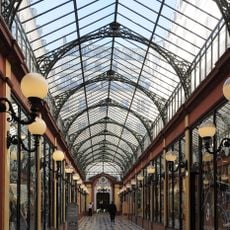
The theatre stands at 7 boulevard Montmartre, beside the passage des Panoramas, in the 2nd arrondissement; Métro Grands Boulevards serves the area. The entrance is on the boulevard, under the wrought-iron gate with gilt finials. The frieze above the ground-level columns reads RUE DE MONTMARTRE, a useful landmark when approaching from the side street.
The theatre appears in Émile Zola's 1880 novel Nana: the heroine Rose Mignon premieres La Blonde Vénus there in April 1867. In Alexandre Dumas's La Dame aux camélias, Marguerite Gautier keeps a box at the Variétés. On 20 June 1907 the theatre hosted the first screening of Michel Carré's L'Enfant prodigue, a 90-minute film considered Europe's first feature-length production.
The community of curious travelers
AroundUs brings together thousands of curated places, local tips, and hidden gems, enriched daily by 94,245 contributors worldwide.