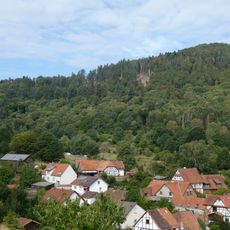
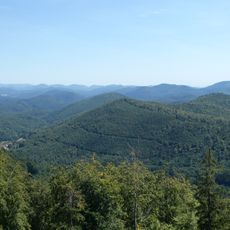
Château de Lœwenstein, Rock castle in Wingen, France.
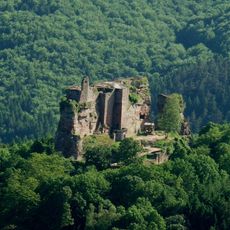
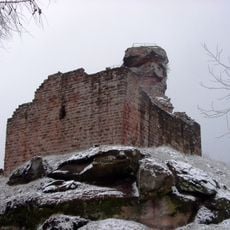
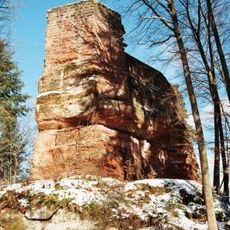
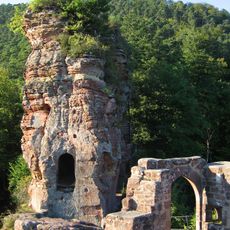
Château de Lœwenstein is a ruined rock castle on two adjacent sandstone outcrops at about 530 metres in the commune of Wingen, Bas-Rhin. The eastern main castle and western forecourt were built directly on the rock; remains include the stair tower, rock-cut steps, passages and a few wall fragments. Only a cistern is still clearly visible.
The castle was first mentioned in the 13th century as a fief of Wolfram von Löwenstein and was granted to Johann Ochsenstein by King Rudolf of Habsburg in 1283. In 1380 it was divided with Hensel Streif von Landenberg, and in 1383 half was pledged to Johannes I von Bitsch. In 1386 Imperial Vicar Johann von Lichtenberg destroyed it for robber-knighthood; it was probably never rebuilt. Later owners included the Puller von Hohenburg (1482), the Counts of Zweibrücken-Bitsch (1485), Hanau-Lichtenberg (1570) and Hesse-Darmstadt (1736). French troops under General Monclar destroyed what remained in 1676–1677.
The site was known by several names throughout history, including Lindenschmitt, which connects to local stories about the knights who lived here. The ruins reveal how people adapted to life in this remote, elevated setting.
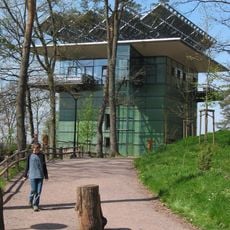
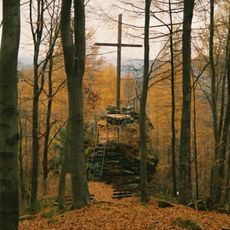
Access follows the Club vosgien trail marked with white discs ringed in red, from the Hohenbourg car park; the route is signposted from there. The site lies at about 530 metres on a southern spur of the Schlossberg, beside the Hohenburg, Wegelnburg and Fleckenstein ruins. Metal staircases and railings lead onto the two flat-topped rocks, where the ground is uneven.
The ruins merge directly with the natural rock formations, creating a composition that blends seamlessly with the surrounding landscape. This integration was strategically clever, making the fortress difficult to spot and approach.
The community of curious travelers
AroundUs brings together thousands of curated places, local tips, and hidden gems, enriched daily by 94,088 contributors worldwide.