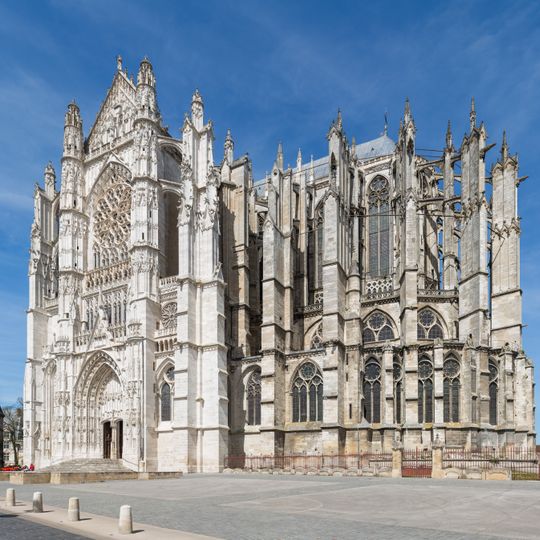
Beauvais Cathedral, Gothic cathedral in Beauvais, France.
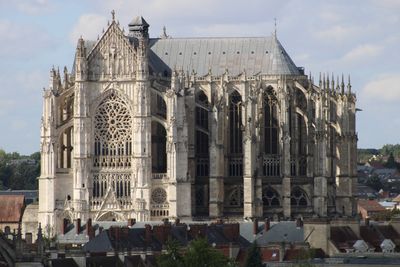
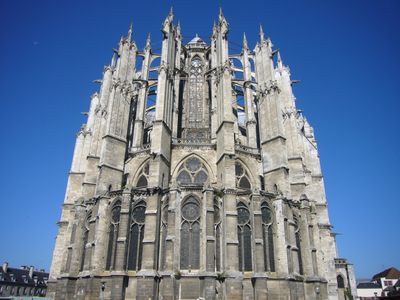
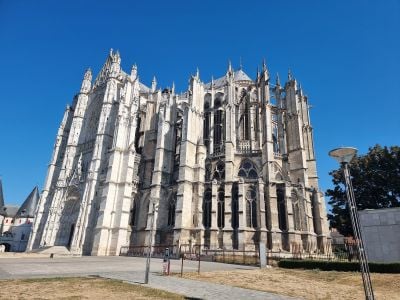
Beauvais Cathedral is a Gothic church whose choir, with an apse and seven polygonal apsidal chapels reached by an ambulatory, rises 48.5 metres under vault. A 16th-century transept joins it, but the nave was never built, so a provisional west wall closes the choir. The pale limestone front has a tall gable flanked by two openwork spires, a deeply recessed pointed portal, a rose window and tiers of blind arcading and statues.
The first works started in 1225 under bishop Milo of Nanteuil, following several fires that destroyed the earlier basilica. A tower added between 1569 and 1573 collapsed shortly after completion and was never rebuilt.
The people of Beauvais call the surviving Carolingian nave the Basse-Œuvre ("Lower Work"), as opposed to the Gothic Haute-Œuvre. On 14 January, the Feast of Asses was celebrated here in commemoration of the Flight into Egypt. The cathedral is also known for its astronomical clock, whose dials and moving figures are a stop for visitors inside the building.
The cathedral stands in the town centre of Beauvais, with the 10th-century Basse Œuvre visible on the west side where the Gothic nave was never built. The north transept is held by four large wood-and-steel trusses installed in the 1990s, and a brace rises from the floor at a 45-degree angle. Look up in the choir to see the 48.5-metre vault, the highest Gothic vault built.
Between 1569 and 1573, the tower here reached a height of 153 meters and stood as the tallest human-made structure in the world. Its collapse ended all further plans to ever complete the building with a full nave.
The community of curious travelers
AroundUs brings together thousands of curated places, local tips, and hidden gems, enriched daily by 93,359 contributors worldwide.