Basse Oeuvre, Carolingian church in Beauvais, France
Basse Oeuvre is the surviving western part of Beauvais's former cathedral, built in the second half of the 10th century in Carolingian style. Its walls are of small cubic stones reused from buildings destroyed in the 3rd-century sack of the city. Reduced to three and a half bays, it is 65 m long with an interior height of 19 m; the facade was rebuilt in the mid-11th century.
The Basse Œuvre was built in the second half of the 10th century as Beauvais's cathedral, with Bishop Hervé (987–998) as master of works. After a 1225 fire, its east end was cut off for the new Gothic chancel; in 1510 three nave bays were lost to the Gothic transept, and around 1600 two buttresses reduced it to three and a half bays. It was restored in 1864–1867.
The name Basse Œuvre, "Lower Work", appears in the 13th century to set the old church apart from the Nouvel-Œuvre, the Gothic cathedral rising beside it. The building was dedicated to Saint Peter, the Virgin and Saint John the Baptist, and served as parish church and baptistery under the Ancien Régime. Closed during the Revolution and used as a wood store, it reopened for worship after restoration in 1864–1867.
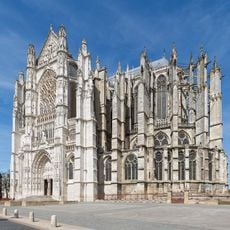
The church stands directly next to Beauvais' Gothic cathedral, making it easy to visit both buildings and compare their architectural styles. The proximity allows you to see the contrast between early medieval and later Gothic construction methods and design choices.
The church's small cubic stones were reused from buildings destroyed during the sack of Beauvais in the 3rd century, which long misled Pierre Louvet, writing in 1614, into dating it to the Gallo-Roman era. Jean Hubert showed in 1938 that the masonry is only reused material and the church is Carolingian.
The community of curious travelers
AroundUs brings together thousands of curated places, local tips, and hidden gems, enriched daily by 92,923 contributors worldwide.