Town hall of Beauvais, 18th-century town hall in Beauvais, France
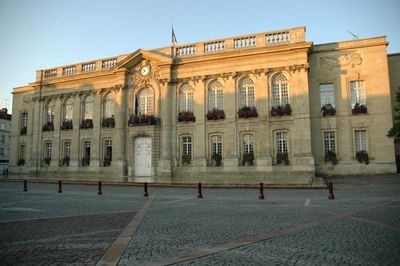
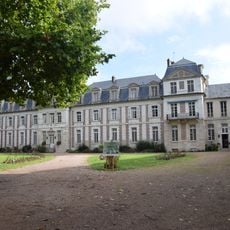
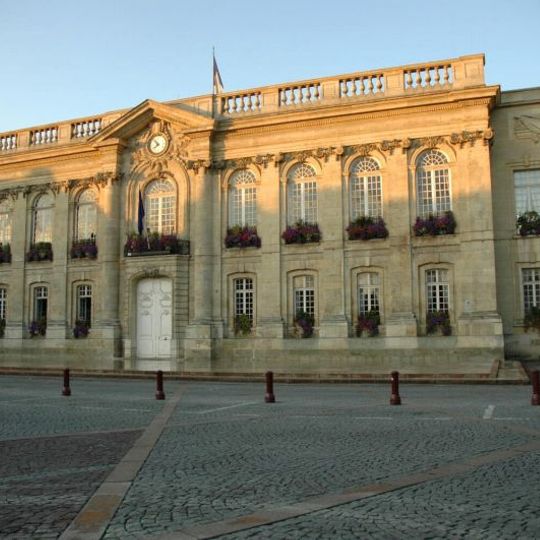
The town hall of Beauvais stands on Place Jean-Hachette, its preserved 1753 neoclassical facade of ashlar stone rising over two symmetrical levels. The central bay has an Ionic-columned entrance, a tall round-headed window, a clock and the city arms with the motto "Palus ut hic fixus, constans et firma manebo", all under a triangular pediment. Two set-back wings added in the 1957 reconstruction carry bas-reliefs by Maurice Debus and Claude Bouscau.
The building was designed and constructed in 1753 during the reign of Louis XV by architect Bayeux. It survived World War II bombings with its front facade largely preserved, and reconstruction in the 1950s restored the property to full use.
The Salle des Mariages, decorated by cabinetmaker Jules Leleu in the third quarter of the 20th century, is a listed monument historique along with its benches, chairs, armchairs and desk. The town hall also keeps a 16th-century tapestry, a painting of Jeanne Hachette at the siege of Beauvais by Jean-Jacques Le Barbier, and a flag commemorating the 1557 battle of Saint-Quentin, called the "drapeau de Jeanne Hachette".
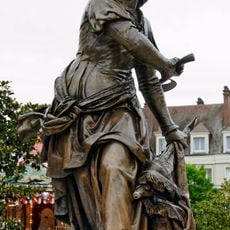
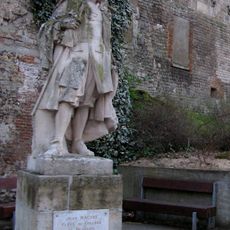
The town hall stands on Place Jean-Hachette, facing the square where the 1851 Jeanne Hachette statue by Gabriel Vital-Dubray was unveiled. The preserved 18th-century facade is best seen from the square itself; the 1957 wings by Georges Noël are set slightly back on either side. The building is an active municipal office, so the interior, including the Salle des Mariages furnished by Jules Leleu, is not freely open.
During reconstruction after 1957, new wings were added featuring bas-reliefs depicting themes of destruction and rebirth of the city. These modern additions create a strong contrast with the classical elements and visually document the city's experience during the war.
The community of curious travelers
AroundUs brings together thousands of curated places, local tips, and hidden gems, enriched daily by 93,975 contributors worldwide.