Château de la Ballue, 17th-century castle and gardens in Bazouges-la-Pérouse, France.
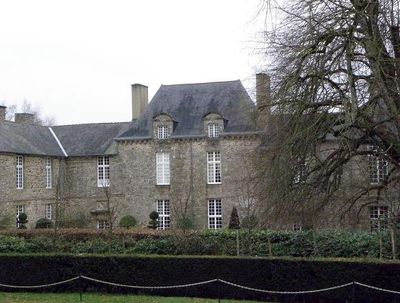
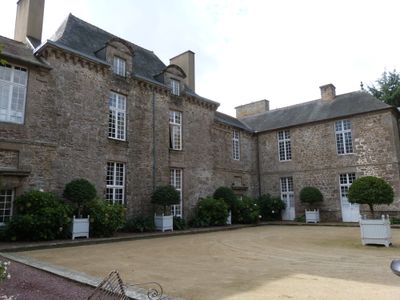
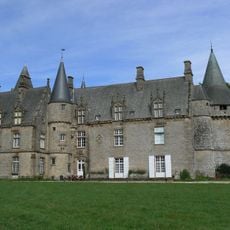
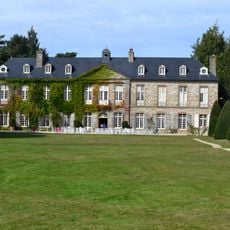
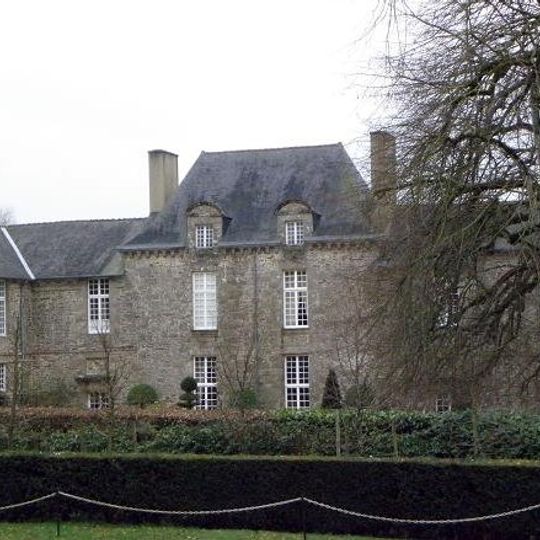
Château de la Ballue is a Louis XIII-style granite castle in Bazouges-la-Pérouse, with a central main building flanked by two returning wings. Its rough grey-brown stone walls, steep grey slate roofs and white-framed windows are visible from the courtyard, where dormer windows with curved pediments sit in the roof. The outbuildings include the great stable, clock tower, cellar, two coach houses and a central passage.
The hill was fortified from early times, marking the boundary between the pays of Combourg and Fougères. Gilles de Ruellan bought the land in 1620 and built the castle, which was rebuilt in 1705. In the 19th century a glassworks occupied the building. The castle and its terraced garden were protected in 1977 and inscribed as monuments historiques on 11 June 1999.
The gardens' topiary terraces and panorama inspired François-René de Chateaubriand, who was born at nearby Combourg. In the 1970s artists such as Niki de Saint Phalle, Robert Rauschenberg and Antoni Tàpies came to draw inspiration from the plant rooms and the yew labyrinth. The 19th-century orangery now serves as an exhibition hall on garden art.
The gardens are the main draw, with terraced topiary, a hornbeam labyrinth and a diagonal garden laid out in 1975. The 19th-century orangery now serves as an exhibition room on garden art. The site lies in Bazouges-la-Pérouse, between the old lands of Combourg and Fougères.
The gardens contain plant mazes and forms that create optical effects through carefully planned perspectives. These spatial illusions invite visitors to explore the grounds from different viewpoints.
The community of curious travelers
AroundUs brings together thousands of curated places, local tips, and hidden gems, enriched daily by 94,657 contributors worldwide.