Musée de l'Homme, Anthropology museum in Trocadéro, France
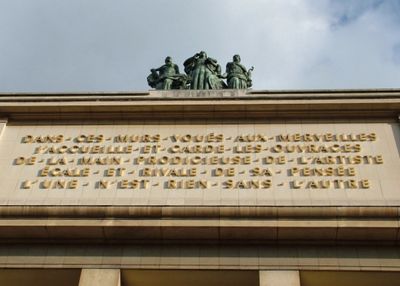
The Musée de l'Homme occupies most of the Passy wing of the Palais de Chaillot, in the 16th arrondissement of Paris. Its light stone facade carries five lines of gold capital letters and three dark green bronze statues on the roofline. Inside, a curved red wall maps the world in white dots, with thin lines running to black plaques; a glass case holds a pale stone bust of a woman.
Paul Rivet founded the institution in 1937 and brought together collections from the former Musée d'Ethnographie du Trocadéro, which opened in 1878 after the World's Fair. Following a complete renovation, the museum reopened in 2015 and has since presented its holdings in redesigned spaces.
The museum's name comes from the French for "human", and its mission, restated in 2015, follows Paul Rivet's line that humanity is one and indivisible in space and in time. The ethnographic collections were moved to the Musée du quai Branly, which opened in 2006, and to MUCEM in Marseille, so the displays now centre on human evolution and societies rather than on objects from every continent. A visitor can read the phrase "7 000 langues, 7 milliards d'Hommes" on the wall text.
The museum sits in the western wing of the Palais de Chaillot and opens Wednesday through Monday, including public holidays. The exhibitions are arranged across multiple floors, so plan a visit with time for breaks between levels.
The collection of Paleolithic fossils ranks among the largest in Europe and includes replicas of famous finds such as Lucy, an Australopithecus afarensis from Ethiopia. Less known is that during World War II the museum became a center of French Resistance, and several staff members actively fought against the occupation.
The community of curious travelers
AroundUs brings together thousands of curated places, local tips, and hidden gems, enriched daily by 93,426 contributors worldwide.