Château de Chantilly, Renaissance château in Chantilly, France.
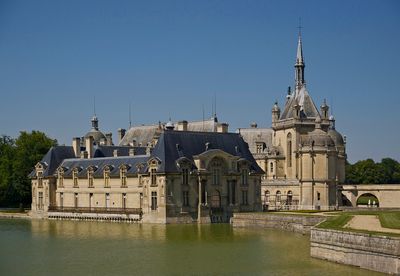
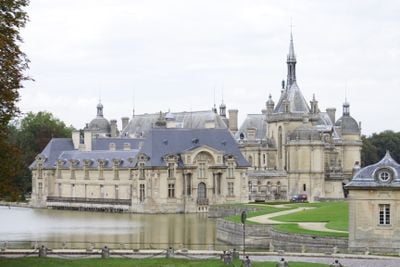
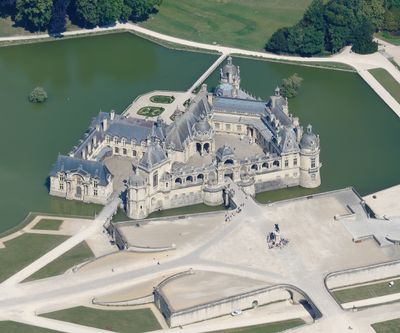
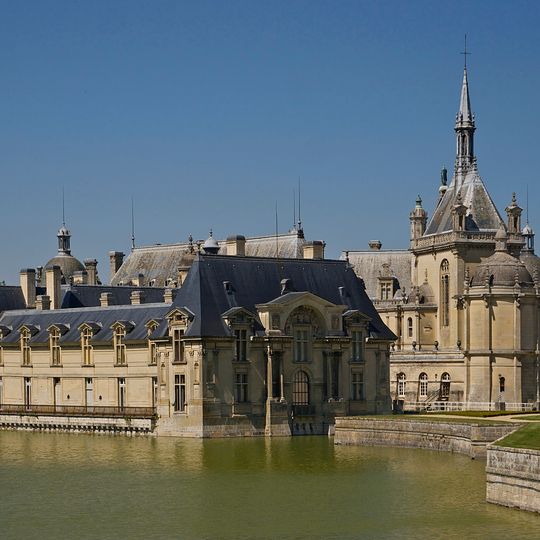
Château de Chantilly consists of two attached buildings: the Petit Château, built around 1560 by Jean Bullant for Anne de Montmorency, and the Grand Château, rebuilt between 1875 and 1882 by Honoré Daumet for the Duke of Aumale. The pale beige stone walls and dark grey slate roofs rise beside a moat-like basin; the Petit Château has a domed tower with a tall spire and cross, while the Grand Château's central section rests on columns above the water.
A fortress stood here from 1386 and later passed into the ownership of the Montmorency family before falling to the Condé branch of the Bourbon house in the 17th century. Architect Honoré Daumet rebuilt the Grand Château after its destruction during the Revolution.
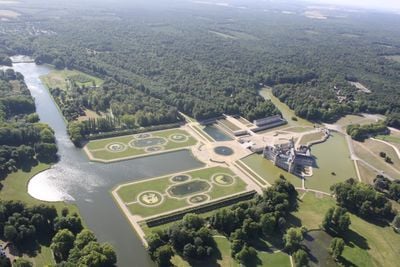
Molière's Les Précieuses ridicules was first performed at Chantilly in 1659 for the Grand Condé, who hosted writers including La Fontaine, La Bruyère and Madame de Sévigné. The two parallel walks framing Le Nôtre's parterres are called the allées des Philosophes in their honour. The Grande Singerie, a salon painted with monkeys engaged in human activities, was restored in 2008.
The château stands in the Nonette valley about 50 km north-northeast of Paris, with the Grandes Écuries and racecourse below the park. The Petit Château holds the Condé princes' 17th- and 18th-century apartments upstairs and the Duke of Aumale's 19th-century rooms on the ground floor. Le Nôtre's Grand Canal stretches 2.5 km, and the Hameau de Chantilly lies within the park.
One of the manuscripts in the library is the 15th-century Très Riches Heures du Duc de Berry, an illuminated book of hours with singular depictions of medieval life. The manuscript is considered one of the most precious works of its kind in the world.
The community of curious travelers
AroundUs brings together thousands of curated places, local tips, and hidden gems, enriched daily by 93,715 contributors worldwide.