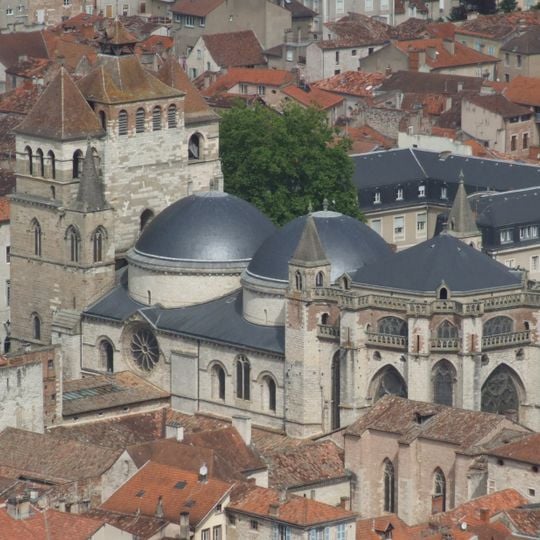
Cahors Cathedral, Medieval Catholic cathedral in Cahors, France
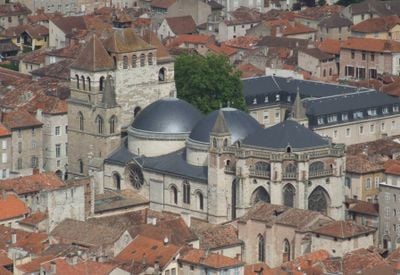
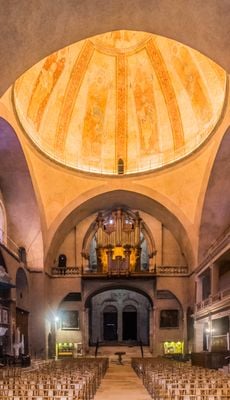
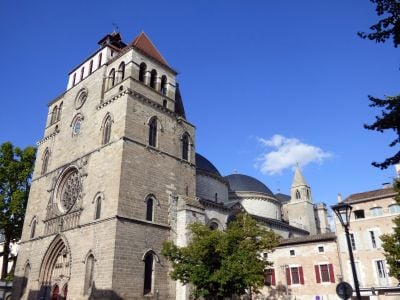
Cahors Cathedral is a Roman Catholic church in Cahors, France, built from the 12th century. It has two 32-metre domes on pendentives, a Romanesque nave and a Gothic choir. The west façade has a porch with a bell tower between two towers, a triple-splayed portal and a large rose window.
A church existed on this site by the 7th century, built under Bishop Didier of Cahors; it was rebuilt after destructions attributed to the Saracens in 732 or to Pepin the Short in 763. Under the Gregorian reform, Bishop Géraud de Cardaillac endowed the chapter, and construction of the present cathedral began in the early 12th century. Pope Calixtus II consecrated the high altar on 27 July 1119, though work continued, with the north portal finished shortly after 1140 according to Mireille Bénéjeam-Lère. Gothic work followed from the late 13th century, and the west front was built around 1309 or earlier.
The north portal is Romanesque, carved in the 12th century, not the 15th; its sculpture belongs to the first building campaign. The south portal is also Romanesque. The Flamboyant Gothic cloister, built from 1504 under Bishop Antoine de Luzech, shows scenes of everyday life and a Madonna.
The nave measures 44 by 20 metres and has no transept, so the two 32-metre domes are seen in one continuous sweep from the entrance. The Romanesque north portal was blocked in the 18th century when a tribune for the canons was built against the north wall; the main entrance is now the western portal. A door right of the choir leads to the cloister.
The relic is the Sainte Coiffe, the Holy Cap, said to have wrapped Christ's head at burial. Bishop Gérard de Cardaillac brought it to Cahors after his 1113 journey to the Holy Land. It is kept in the apse, near the tomb of Alain de Solminihac.
The community of curious travelers
AroundUs brings together thousands of curated places, local tips, and hidden gems, enriched daily by 93,443 contributors worldwide.