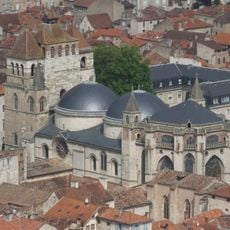
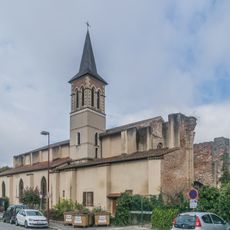
Église Saint-Urcisse de Cahors, Romanesque church in Cahors, France
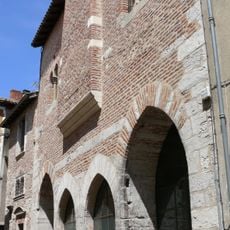
Église Saint-Urcisse is a parish church near the Lot in Cahors, built in the transition from Romanesque to Gothic art in Quercy. Its facade has a tall central gable in tan plaster with a stone-traceried rose window above a pointed-arch portal framed by layered arches and divided by a stone trumeau. Flanking bays mix rough red brick with pale stone blocks, and a stone tower with a pyramidal roof rises to the right.
The church is first documented in the Vita sancti Desiderii as the basilica of Saints Saturnin and Urcisse, and it appears again in a 12th-century cartulary during a dispute between the abbot of Marcilhac and the cathedral chapter. Géraud III de Cardaillac had given it to Marcilhac, and the quarrel ended in 1188 with the church and its mill kept by the abbey against an annual rent. It became a Marcilhac priory, passed to the bishop's collation by the late 17th century, was sold as national property in 1791 and used as a saltpetre workshop and store before returning to worship after the 1801 concordat.
The church is named after Saint Urcisse, bishop of Cahors, who died around 595 and was soon venerated as a saint. A document from the time of Bishop Didier names it the "basilica of Saint-Saturnin and Saint-Urcisse"; later the dedication to Saturnin was dropped, though no source records when. In 1188 a dispute between the abbey of Marcilhac and the cathedral chapter ended with the church and its mill held by the abbey against an annual rent.
The church is closed to the public because the structure is unstable, and it can only be approached from the west side; the other three sides are blocked. Visitors can still study the facade from the street, where the pointed portal, rose window and brick-and-stone bays are visible.
The church was sold as national property in 1791 to M. Plantade, its former priest, and served as a saltpetre workshop and then a shop before returning to worship after the 1801 Concordat. Its bell tower was rebuilt in the mid-1860s because the old one could not house the bells.
The community of curious travelers
AroundUs brings together thousands of curated places, local tips, and hidden gems, enriched daily by 93,870 contributors worldwide.