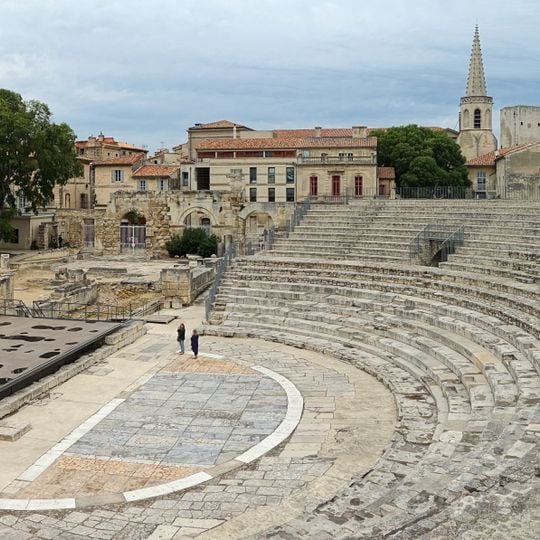
Gallo-Roman theatre at Arles, Roman theatre in Arles, France.
The Gallo-Roman theatre at Arles has a semicircular cavea 102 metres in diameter, its 33 rows of weathered stone seats rising toward the hill of Hauture. At the base, the orchestra floor of grey and tan slabs is bordered by a curved white band. Two Corinthian columns, the only survivors of about a hundred, stand beside broken structures at the stage wall.
Construction began around 40–30 BC and was completed by 12 BC, making it one of the earliest stone theatres in the Roman world. The emperor Constantius II attended a grand performance there on 10 October 353, and the venue remained in use until the early 5th century, when the Church quarried its stones for the Basilica of Saint Stephen.
The site was dedicated to Apollo, not Dionysus, and the orchestra still shows the sealing trace of an altar to the swans, Augustus's emblem. The two remaining columns are called "the two widows." From late June to late August it hosts the Fêtes d'Arles et du costume, the Rencontres Internationales de la Photographie, the Festival des Suds and the Festival du film péplum.
The site sits on the slope of the Hauture hill, so the ground between the orchestra, the two columns and the remaining cavea section is uneven and partly stepped. Metal barriers and a lighting truss cross the seating area. Allow time to move between the lower paving and the upper tiers.
A marble statue of Venus was unearthed from the theatre ruins in 1651 and now resides in the Louvre Museum. This discovery reveals how archaeological work continues to surface valuable artworks hidden within the ancient remains.
The community of curious travelers
AroundUs brings together thousands of curated places, local tips, and hidden gems, enriched daily by 93,655 contributors worldwide.