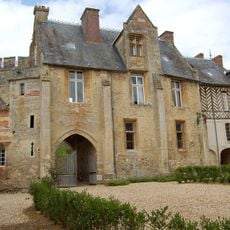
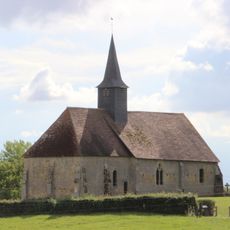
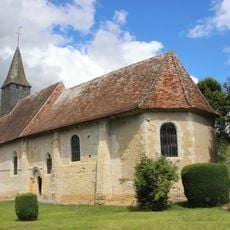
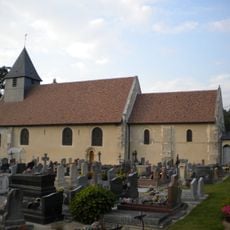
Abbey of Val-Richer, Cistercian monastery in Saint-Ouen-le-Pin, France.
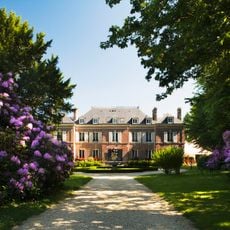
The Abbey of Val-Richer is a former Cistercian monastery in Saint-Ouen-le-Pin, about eleven kilometres west of Lisieux. Its surviving 17th-century abbatial lodging, rebuilt under Dom Dominique Georges, is a classical-style building of light tan and beige stone with dark quoins, a steep grey slate roof, two brick chimneys, a small wooden bell turret and dormer windows. The church, cloister and convent buildings were demolished in 1802.
The monastery was founded in 1143 by Philippe de Harcourt, Bishop of Bayeux, as a center of religious life. It underwent major reconstruction in the 17th century but sustained damage during the French Revolution.
The name Val-Richer comes from Vallis Richerii, the Latin form used in the monastery's own documents. Thirty choir stalls from the abbey, carved under Louis XIV, were moved to the church of Saint-Jacques in Lisieux after the 1802 demolition. The site later passed by marriage to the Schlumberger family, and a brick laboratory built for the Schlumberger brothers is listed as a historic monument.
The site lies in Saint-Ouen-le-Pin, about eleven kilometres west of Lisieux. The 1991 inscription covers the abbot's lodging with its fixed decorations, the north-west return wing and the main farm building; the 2008 inscription adds the keeper's and gardener's houses, the Schlumberger laboratory in its entirety and the kitchen garden.
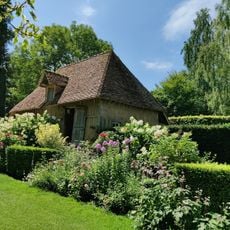
A brick laboratory building on the grounds belonged to the Schlumberger brothers, descendants of François Guizot through his daughter Henriette and Conrad de Witt. Its entire structure was listed as a monument historique by decree on 16 June 2008, together with the keeper's and gardener's houses and the kitchen garden.
The community of curious travelers
AroundUs brings together thousands of curated places, local tips, and hidden gems, enriched daily by 94,071 contributors worldwide.