St. Desir-de-Lisieux German war cemetery, German military cemetery in Saint-Désir, France.
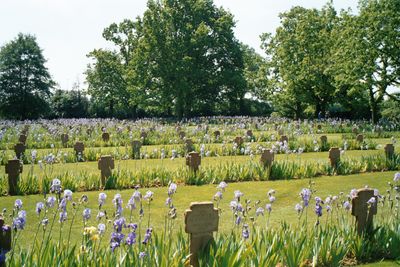
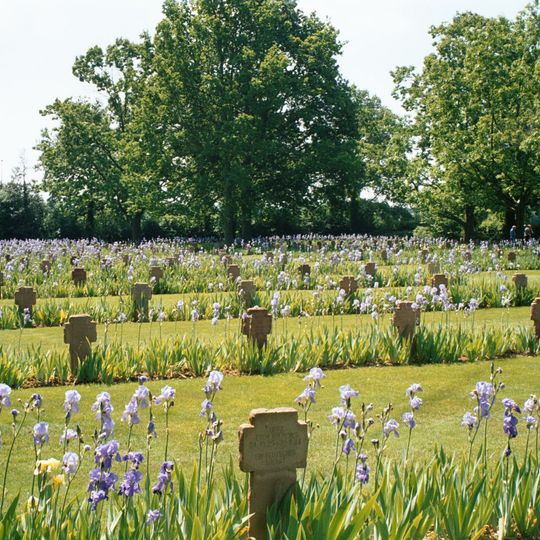
Saint-Désir-de-Lisieux is a German war cemetery of 3,735 graves, the smallest German military cemetery in Normandy, beside the British Saint-Désir War Cemetery west of Lisieux. Low pale stone markers stand in long rows among low plants and tall purple and white flowers, with large leafy trees at the rear. One foreground marker is carved "EIN DEUTSCHER SOLDAT".
The British Graves Registration Commission created the cemetery in August 1944, burying British and German casualties in adjacent fields. Most of the German dead were killed in the final days of the Battle of Normandy and in the Falaise Pocket that August, many from the 7th and 15th Armies and 7th Panzer Army. German soldiers from field graves and small local cemeteries were later disinterred and brought here. The Volksbund Deutsche Kriegsgräberfürsorge remodelled and expanded the site in the late 1950s, and it was inaugurated as a German war cemetery on 21 September 1961.
The cemetery is maintained by the Volksbund Deutsche Kriegsgräberfürsorge, which relies on donations and collections rather than state funding. In summer, international school pupils volunteer during their holidays, tending the graves and attending a memorial ceremony with veterans and the mayor of La Cambe.
The cemetery is located west of Lisieux in Normandy and is easy to reach by car or local transport. Visitors should move slowly through the rows of graves and maintain a respectful attitude, as this is a place of remembrance.
The cemetery is the smallest German war cemetery in Normandy, and it is where newly found German war dead from across the region are usually brought for burial. Its graves include fighter pilots Horst Hannig, Kurt Ubben, Egon Mayer and Eugen-Ludwig Zweigart.
The community of curious travelers
AroundUs brings together thousands of curated places, local tips, and hidden gems, enriched daily by 94,529 contributors worldwide.