Château du Landsberg, Medieval castle in Heiligenstein, France.
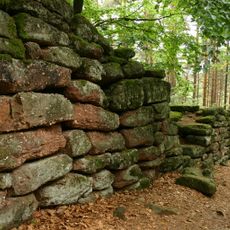
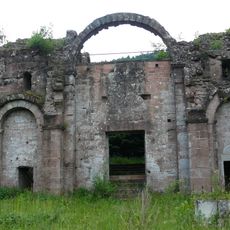
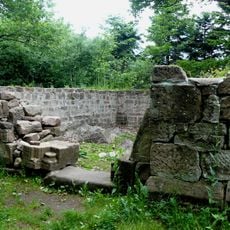
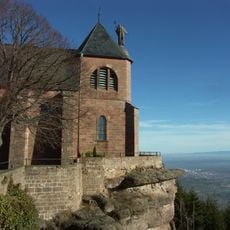
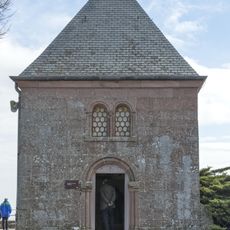
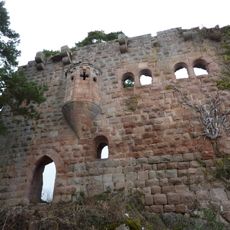
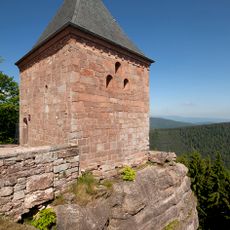
Château du Landsberg stands at 580 m on a granite spur below Mont Sainte-Odile, in Heiligenstein. Two separate castles are divided by a ditch: the old castle, built just before 1200, with a square keep protecting a palace, and the new castle to the west, built around 1235, square in plan with three curtain walls, two round corner towers pierced with arrow slits and two dwellings. The east façade of the old palace keeps a 12th-century oriel with a cross-shaped opening, the choir of the castle chapel, once painted with a blessing Christ among angels.
Conrad de Landsberg built the fortress between 1197 and 1200 to protect the abbeys of Hohenbourg, Niedermunster, and Andlau from attacks. It was part of a larger strategy to secure church properties in the region.
The castle's name comes from Conrad von Vienhege, who called himself "von Landsberg" after building it. Each January to March, the slopes around the ruins are carpeted with Eranthis hyemalis, called Schlosselblum in Alsatian. A local legend says a knight brought the flower back from the Crusades for his beloved.
The ruin stands at 580 m on a granite spur above Heiligenstein, reached on foot; the climb is steady and the ground around the walls is uneven, with dry brush and scrub underfoot. The site is private property, so keep to the paths and leave the masonry as you find it. The winter aconite (Schlosselblum) flowers in carpets near the castle from January to March.
The winter hellebore, called Schlosselblum in Alsace, grows wild in France's east only at the foot of these ruins, flowering in a carpet from January to March. Doctor Théodore Boeckel noted it here in 1823, and Frédéric Kirschleger described it as rare in the Vosges in 1831. Its crushed rhizome was once thought to cure ulcers on the nostrils of donkeys and horses.
The community of curious travelers
AroundUs brings together thousands of curated places, local tips, and hidden gems, enriched daily by 94,657 contributors worldwide.