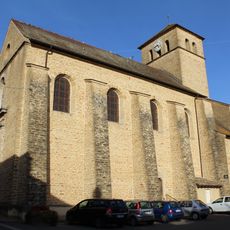
Chapelle des Moines, Romanesque church in Berzé-la-Ville, France
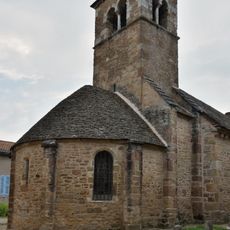
Chapelle des Moines is a Romanesque chapel in Berzé-la-Ville, built of large ashlar blocks and covered with stone slabs. It has a short, tall nave of three bays whose side walls are decorated with Lombard bands, followed by a lower choir bay and a semicircular apse with strong pilasters. A lower chapel with a barrel vault lies beneath the upper one.
Berzé-la-Ville is first mentioned in 1042 under the priory of Marcigny-en-Brionnais. In 1100 Abbot Hugh of Semur (1049–1109) obtained lordship over the village for Cluniac novices, and the new priory was named Château des Moines. The wall paintings were probably begun around 1103 and were unfinished at his death. The priory buildings were renewed in 1740, suppressed at the Revolution, and the upper chapel became a barn until the frescoes were rediscovered in 1887.
The apse half-dome shows the Traditio Legis: Christ in a mandorla hands a scroll and the keys to Peter, flanked by two groups of six apostles, with the deacons Vincent and Lawrence and two Cluniac abbots drawn smaller. More than 40 figures fill the space, painted in seven colours including cinnabar and lead white.
Check opening hours before visiting, as access times vary throughout the year and the chapel operates on a limited schedule. It is worth arranging a tour ahead of time to make the most of the experience.
The murals were probably made for a visit by Pope Boniface VIII and nine cardinals to Cluny and its priories. Painted in five layers from a palette of seven colours, they fit more than 40 figures into the apse, including the deacons Vincent and Lawrence and two Cluniac abbots.
The community of curious travelers
AroundUs brings together thousands of curated places, local tips, and hidden gems, enriched daily by 94,657 contributors worldwide.