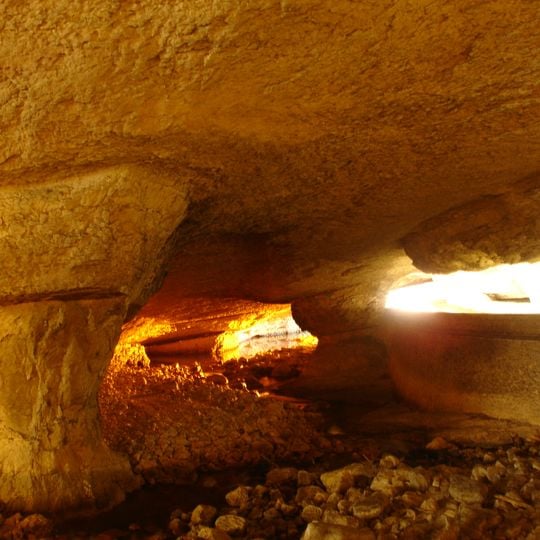
Grotte du Mas-d'Azil, Prehistoric cave system in Le Mas-d'Azil, France.
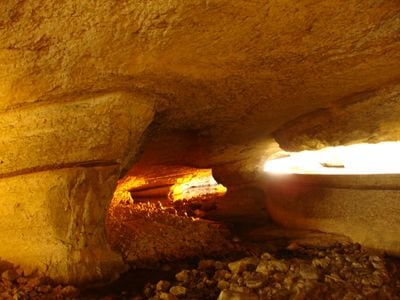
Grotte du Mas-d'Azil is a cave in Thanetian limestone, 2,100 m long, on the right bank of the Arize. Its southern entrance, the Porte de l'Arize, is 51 m high and 48 m wide. A natural tunnel 420 m long and about 50 m wide carries the D 119 road alongside the river for 410 m. The photographs show a broad limestone arch with a smaller opening beside it and, inside, a rough amber-brown ceiling above a rubble floor.
The site reveals evidence of human settlement spanning 20,000 years, with discoveries of tools, weapons, and over 1,300 painted pebbles from prehistoric periods. These finds document how early people used this place across many successive generations.
The cave gave its name to the Azilian, an Epipaleolithic culture (around 12,000 to 9,500 years BP) known for flat harpoons and painted pebbles in red ochre. Decorated galleries such as the Breuil and Reindeer galleries hold engravings of bison, fish, horse hindquarters, an ibex head and a human face; nine human representations were recorded in 1992.
The cave lies 1 km south of Le Mas-d'Azil village, on the right bank of the Arize, in the Plantaurel massif. The D119 road runs through the natural tunnel for 410 m alongside the river, so you can drive through the cave itself. The site is part of the Ariège Pyrenees Regional Natural Park, created in 2009.
The cave is one of the very few in Europe that a car can drive through, alongside the Cuevona in the Cuevas del Agua in Asturias, Spain. The D 119 road follows the Arize for 410 m inside the natural tunnel, which is 420 m long and averages 50 m wide. The road's construction, based on an 1857 plan, brought the archaeological remains to light.
The community of curious travelers
AroundUs brings together thousands of curated places, local tips, and hidden gems, enriched daily by 93,401 contributors worldwide.