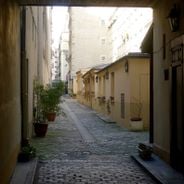
Galerie Vivienne, Neoclassical covered passage in 2nd arrondissement, France.
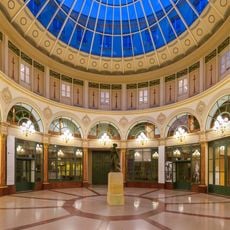
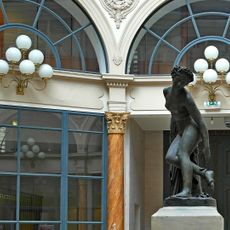
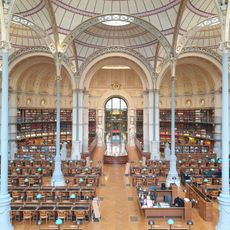
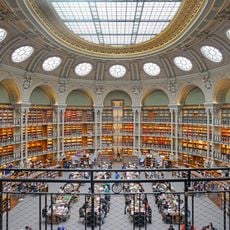
Galerie Vivienne is a 176-metre covered passage, 3 metres wide, linking Rue des Petits-Champs, Rue de la Banque and Rue Vivienne. Its long arcade has a glazed barrel-vaulted roof on pale stone arches, cream walls with arched openings, and mosaic floors signed by Giandomenico Facchina and Mazzioli. A 42-metre gallery leads to a glazed rotunda with a hemispherical glass dome.
The structure was built in 1823 under Louis-Auguste Marchoux and designed by François-Jacques Delannoy before opening to the public in 1826. Its importance led to historical monument status in 1974, reflecting the city's appreciation for this part of its architectural legacy.
The name comes from Rue Vivienne, itself named after Louis Vivien, a Paris alderman in 1599. The gallery is twinned since 12 September 2019 with the Galeries royales Saint-Hubert in Brussels. Its mosaic floor is signed by Giandomenico Facchina and Mazzioli.
The gallery is a private co-ownership, but pedestrians may walk through free of charge during public opening hours. Entrances are at 4 Rue des Petits-Champs, 5-7 Rue de la Banque and 6 Rue Vivienne; the Bourse metro station (line 3) is the nearest. The passage is 176 metres long and only 3 metres wide, so expect to pass close to other walkers.
The rotunda's hemispherical glass dome is original to the 1823 building and was designed to let air circulate. The floor mosaics, signed by Giandomenico Facchina and Mazzioli, use a terrazzo base and simple geometric shapes. The gallery was twinned with Brussels' Galeries Royales Saint-Hubert on 12 September 2019.
The community of curious travelers
AroundUs brings together thousands of curated places, local tips, and hidden gems, enriched daily by 93,526 contributors worldwide.