Palais de l'archevêché d'Aix-en-Provence, 17th-century Archbishop's Palace in central Aix-en-Provence, France.
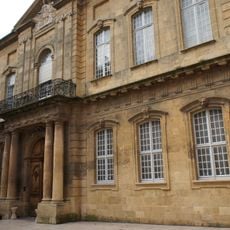
The Archbishop's Palace is a 17th-century episcopal residence in central Aix-en-Provence featuring a grand stone facade with classical proportions and a decorated main entrance. The building extends across multiple floors with rooms that once served as living quarters for church leaders and now house collections and exhibition spaces.
Construction of this palace began in 1650 and continued until 1730 under architect Laurent Vallon's direction, creating a grand home for the city's religious leaders. The long building process shows how architectural styles evolved over the decades from early to late 17th-century tastes.
The tapestry museum, created in 1909 and now called Musée du Palais, occupies the first-floor state rooms, not the ground floor. Its three suites are the Grotesques after Jean-Baptiste Monnoyer (around 1680), the Story of Don Quixote after Charles-Joseph Natoire (1735–1745), the only surviving set, and the Russian Games after Jean-Baptiste Leprince (1770).
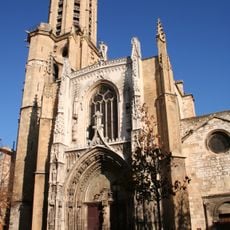
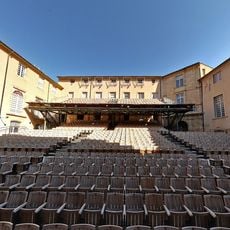
The palace stands in the north of the old town, directly east of Saint-Sauveur Cathedral, and the courtyard is reached from the surrounding streets. The tapestry museum occupies the first floor, in the state rooms, so plan to climb the 1670 double-revolution staircase. The courtyard is used for the July opera festival and is then closed to casual visitors.
The palace stands on the foundations of the Roman forum of Aquae Sextiae; walls of two Roman insulae were found about 80 cm to 2 m below the courtyard during excavation work for the 1984-1985 renovation of the festival theatre. The arms above the portal are those of Mgr de Bausset-Roquefort, archbishop in 1817.
The community of curious travelers
AroundUs brings together thousands of curated places, local tips, and hidden gems, enriched daily by 94,110 contributors worldwide.