Cathedral of the Holy Saviour, Catholic cathedral in Aix-en-Provence, France
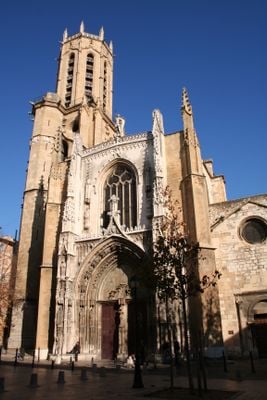
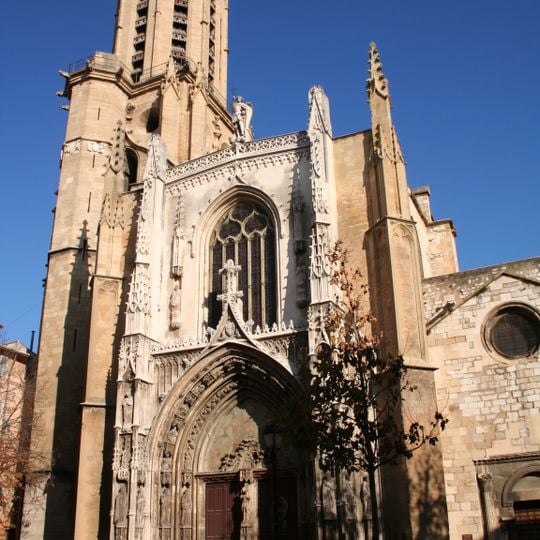
The Cathedral of the Holy Saviour stands on rue Gaston-de-Saporta, 70 metres long and 46 wide, with 20 metres to the keystone of its vault. Its pale grey-beige west front shows three building phases: the bare Romanesque nave wall of the 12th century, a wall of antique bossed blocks, and the 16th-century Gothic portal. A flat-topped tower with paired lancet openings rises on the left; a lower wall with a rose window stands on the right.
Construction began in the 12th century on the site of a Roman forum, incorporating remnants of a 6th-century Christian baptistery. The structure expanded over subsequent centuries as successive generations added artistic and architectural elements to the building.
The cathedral keeps the walnut doors carved in 1505 by the Bolhit brothers of Aix and the Toulon sculptor Jean Guiramand, showing the prophets Isaiah, Ezekiel, Daniel and Jeremiah beneath twelve Sibyls, pagan seers honoured for foretelling Christ. The figures are framed by garlands of pomegranates, acorns and grapes.
The cathedral is on rue Gaston-de-Saporta, not on Place de l'Université. The baptistery, with its octagonal pool and reused Roman columns, is entered from the nave; a viewing hole in its floor shows the bases of the Roman forum porticoes. The cloister, built on the old Roman square, is reached from the church.
The walnut doors, commissioned in 1505, were carved by the Aix brothers Raymond and Jean Bolhit with the Toulon sculptor Jean Guiramand, who cut the twelve Sibyls in 1508. The four high-relief prophets are framed by garlands of pomegranates, acorns and grapes, with a lion, a dragon, an aspic and a basilisk among the carvings.
The community of curious travelers
AroundUs brings together thousands of curated places, local tips, and hidden gems, enriched daily by 93,483 contributors worldwide.