Ménez-Hom, Mountain and observation point in Finistère, France.
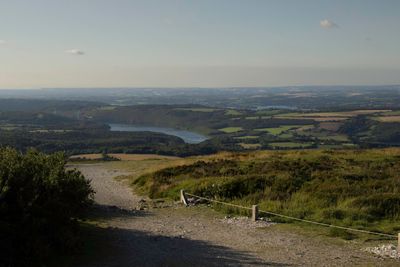
Ménez-Hom is a 329-metre hill of Armorican sandstone, the westernmost summit of the Montagnes Noires, shared by the communes of Plomodiern, Saint-Nic, Trégarvan and Dinéault. It has two main tops about 800 metres apart, the Yelc'h and the Yed, and a col at 212 metres. A narrow road climbs from the south to within a few metres of the summit, where a stone table stands.
The summit's Breton name Yed means "watch", reflecting its use as a lookout against invaders. In 1976 a criminal fire destroyed 1,500 hectares of pine forest and two houses despite the efforts of 250 firefighters. Since 14 July 2011, Landes de Bretagne and Avranchin sheep have grazed heathland parcels in summer to reduce fire risk.
In Breton the mountain is Menez C'homm: menez means mount, while komm (mutated to C'homm) meant valley in old and middle Breton, so the name reads as the mount of the Aulne valley below. Another reading links komm to "trough", after the shape formed by the two summits. A chapel Saint-Come stands at Saint-Nic, and the name has been tied to the twin saints Come and Damien.
You can reach the summit via several marked hiking trails, with parking areas nearby for easy access. Paragliders will find designated launch sites and landing zones when conditions are suitable for flying.
Ménez-Hom is not a volcano, although some tourist guides still call it one. The confusion traces back to an 1880s scientific paper by Charles Barrois whose title mentioned "Silurian diabase eruptions of Menez-Hom", though Barrois knew the flows lie exposed in the Trégarvan cliffs below. The summit itself is Armorican sandstone about 480 million years old, which local legend calls impossible to pierce or break.
The community of curious travelers
AroundUs brings together thousands of curated places, local tips, and hidden gems, enriched daily by 93,713 contributors worldwide.